Web Lesson 13: Transformations 1
The Interactive Web-Lesson below has questions embedded
So do it carefully, as your answers are sent to me!
- When a question pops up, if you want to see the movie again, click ‘Hide’ (top right corner)
- You CAN'T retry a ‘flopped’ question: So PAY ATTENTION and THINK!
- When you get a question ‘CORRECT’, you'll get an opportunity to ‘SKIP’ the explanation:
Click the arrow in the right (but be quick!)
Transformations 1 > Translations and Reflections
Rule 1:
Makes sure the brackets are shown. Fractions often have brackets that we don't bother to show:
         y  =     1        should be written:    y  =     1
                x - 2                                 ( x - 2 )
But, if there are no brackets, shown, then put brackets around the 'x':
y = 4 - sin x can be written as: y = 4 - sin(x)
Rule 2:
The term with 'x' in it should be the first term. If not, then swap the terms:
        y  =  4  -  x³   can be written as:    y  =  - x³  +  4
             ╘═╛╘═════╛                             ╘════╛╘════╛
Rule 3:
‘+k’ INSIDE the brackets shifts the curve by ‘-k’ along x
Rule 4:
A ‘+C’ OUTSIDE the brackets shifts the curve by ‘+C’ along y
Rule 5:
A ‘–’ (i.e. a negative sign, or a ‘×-1’) OUTSIDE the brackets reflects the curve in the x-axis
Rule 6:
A ‘–’ (i.e. a negative sign, or a ‘×-1’) OUTSIDE the brackets reflects the curve in the y-axis
In addition to the y = x² and the y = x³ curves, there are some other curves that you should know the shapes of:
.
The Recip Curve:
Below is a graph of the \(y=\frac{1}{x}\) curve (also called the "Reciprocal Curve"):
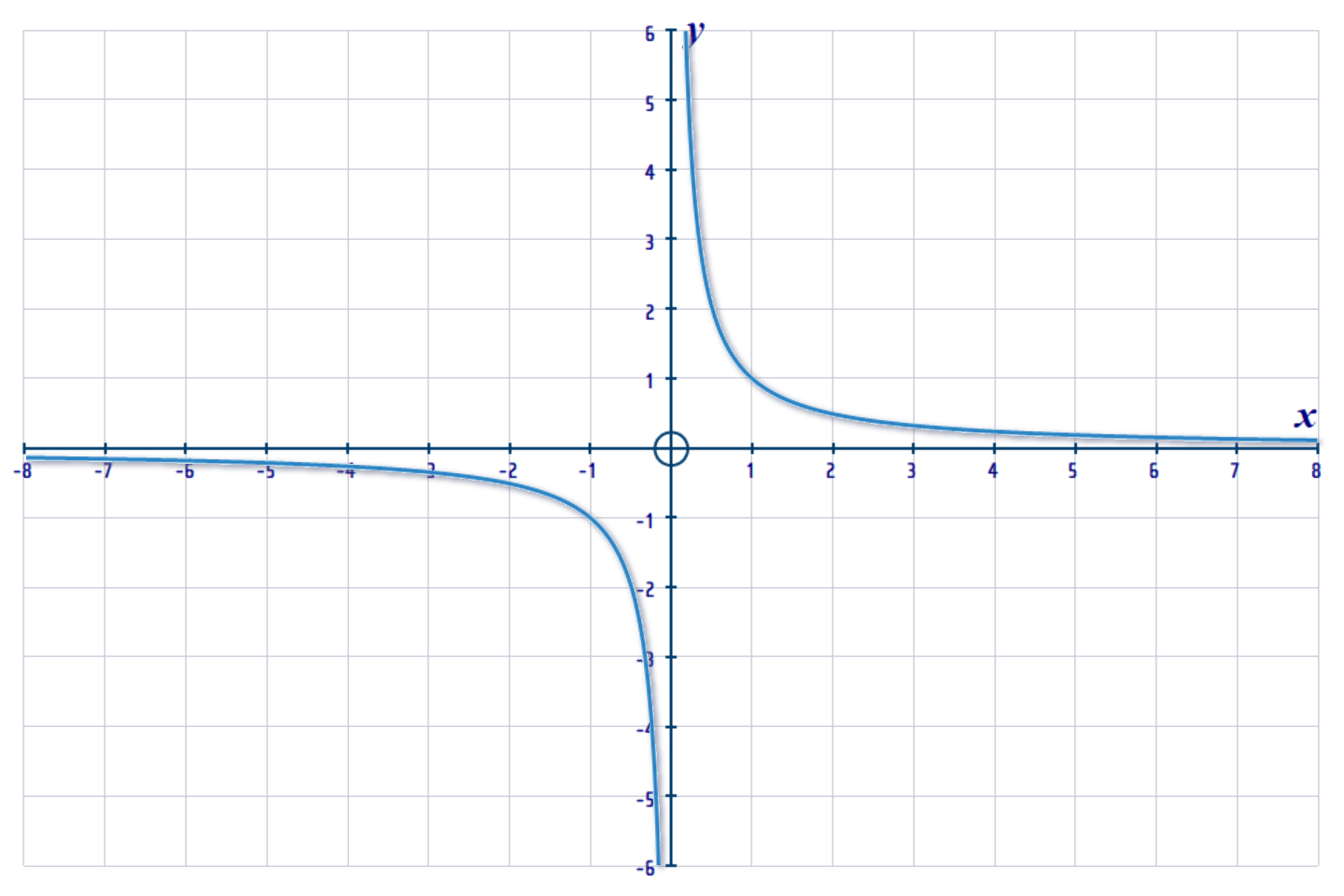
This curve has no y-intercept and it has no root, but it does have TWO ASYMPTOTES:

These are the DOTTED lines that the curve gets extremely close to, but never touches!
The horizontal asymptote is \(y\,=\,0\) (i.e. just the \(x\)-axis)
The vertical asymptote is \(x\,=\,0\) (i.e. just the \(y\)-axis)
Starting with the curve of \(y=\frac{1}{x}\) (as shown above) and by using the same methods as in the movie, sketch the following curves.
Use squared or graph paper and use a different grid for each curve:
For each question, you must:
- State clearly what transformations are needed
- Show where the asymptotes are on the transformed curve
- Identify any roots/intercepts
Question 1: Sketch: \(y\,\,=\,\,2-\frac{1}{x}\)
Clue:

In the Web Lesson, I didn't start with a flow diagram - but in these hints (and in your workings)
I wanna see a FLOW-DIAGRAM:

                          y  =  2 -  1
                          ▲ ▲      ( x )
                          └─│──────────────────────────┐
                            └──────────┐               │
                                       │               │
                                     ┌─┴─┐           ┌─┴┐
      x ──────────► RECIP ──────────►│×-1│──────────►│+2│
                   └──┬──┘           └─┬─┘           └─┬┘
                     f(x)              │               │
                            ┌──────────┘               └──────────┐
                      ┌─────┴─────────────┐                       │
                      │‘×-1’ is after f(x)│                       │
                      │ REFLECT IN x-AXIS │        ┌──────────────┴───────┐
                      └───────────────────┘        │  ‘+2’ is after f(x)  │
                                                   │ TRANSLATE ⍰ along y	│
                                                   └──────────────────────┘

After you've sketched the transformed curve, don't forget to show the new asymptotes
and the new x-intercept (root)…
Question 2: Sketch: \(y\,\,=\,\,-\frac{1}{x+3}\)
Clue:

Since there is a 'sum' in the denominator, there should be brackets around the denominator:

                    y  =  —   1
                          ▲(x + 3)
                          │   ▲
                          └───│────────────────────────┐
                     ┌────────┘                        │
                     │                                 │
                   ┌─┴┐                              ┌─┴─┐
      x ──────────►│+3│───────────► RECIP ──────────►│×-1│
                   └─┬┘            └──┬──┘           └─┬─┘
                     │              f(x)               │
                     └──┐                              └──────┐
                 ┌──────┴───────────────┐                     │
                 │ ‘+3’ is before f(x): │                     │
                 │TRANSLATE ‘-3’ ALONG x│       ┌─────────────┴─────┐
                 └──────────────────────┘       │‘×-1’ is after f(x)│
                                                │ REFLECT IN x-AXIS │
                                                └───────────────────┘

After you've sketched the transformed curve, don't forget to show the new asymptotes
and the new y-intercept…
Question 3: Sketch: \(y\,\,=\,\,2-\frac{1}{x-1}\)
Clue: Since there are no brackets, first put a brackets around the x:

                    y  = 2  -    1
                              (x - 1)

      The FLOW DIAGRAM looks like this:

      x ──────────► -1  ───────────► RECIP ──────────► ×-1 ──────────► +2
                   └─┬┘             └──┬──┘           └─┬─┘           └─┬┘
                     ①               f(x)              ②              ③
          ┌──────────┴──────────┐                       │               │
           ‘+3’ is before f(x):                         │               │
          TRANSLATE ‘+1’ ALONG x           ┌────────────┴─────┐         │
                                           ‘×-1’ is after f(x)          │
                                            REFLECT IN x-AXIS      ┌────┴────┐
                                                                    BLAH-BLAH


      After you've sketched the transformed curve, don't forget to show the new asymptotes…
You can use this applet to check your answers to Questions 1, 2 and 3:
Question 4: Sketch \(y=\frac{3x+13}{x+4}\)
Clue:

At first, you should think, ‘but x appears in two places, so you can't use transformations
to sketch this’

Which is true - you can only use transformations with equations where x appears only once!

But then you think, ‘so how does he expect me to do this?’

And slowly, you remember POLYNOMIAL DIVISION:

We need to re-write: (3x+13) ÷ (x+4) and polynomial division will allow us to do that:

                 ┌─────────────
          x + 4  │   3x + 13
          │           └────────────────────────────────────────────────────┐
          └──────────────────────────────────────────────────┐             │
The first question we have to ask is, " what do you multiply x by, to get 3x "

The answer (obviously) is: ‘3’

So we put a ‘3’ on the TOP of the division and multiply it out:

          ┌───┌────── 3
          │   │  ┌─────────────
          x + 4  │   3x + 13

Which gives:

          ┌───┌────── 3
          │   │  ┌─────────────
          x + 4  │   3x + 13
                     3x + 12

Then, we ‘subtract’:

                      3
                 ┌─────────────
          x + 4  │   3x + 13
          │       ──(3x + 12)
          │       -----------
          │                1
          │                └─────────────────────────────────────────────────────────┐
          └─────────────────────────────────────────────────────────────┐            │
Now, at this stage, there is NO POINT in asking, " what do you multiply x by, to get 1 "
(because you'd have to divide (not multiply) by x)

So, we STOP and re-write as:

                             QUOTIENT   +   REMAINDER
                                             DIVISOR  .

And now we've re-written it with x in 1-place, so we can use TRANSFORMATIONS to sketch it!
The Sine Curve:
Below is a graph of the \(y=\sin x\) curve (also called the "Sine Curve"):
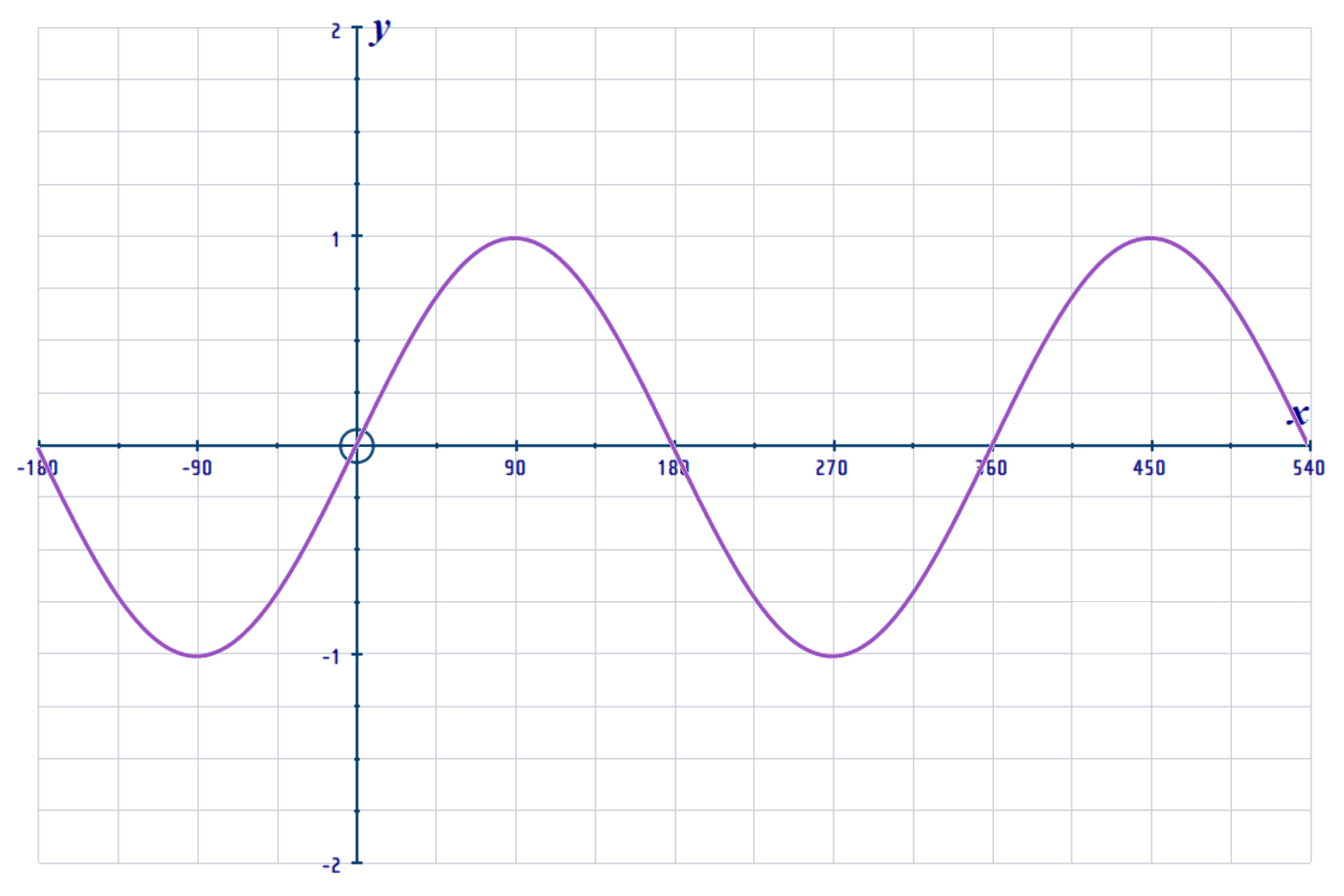
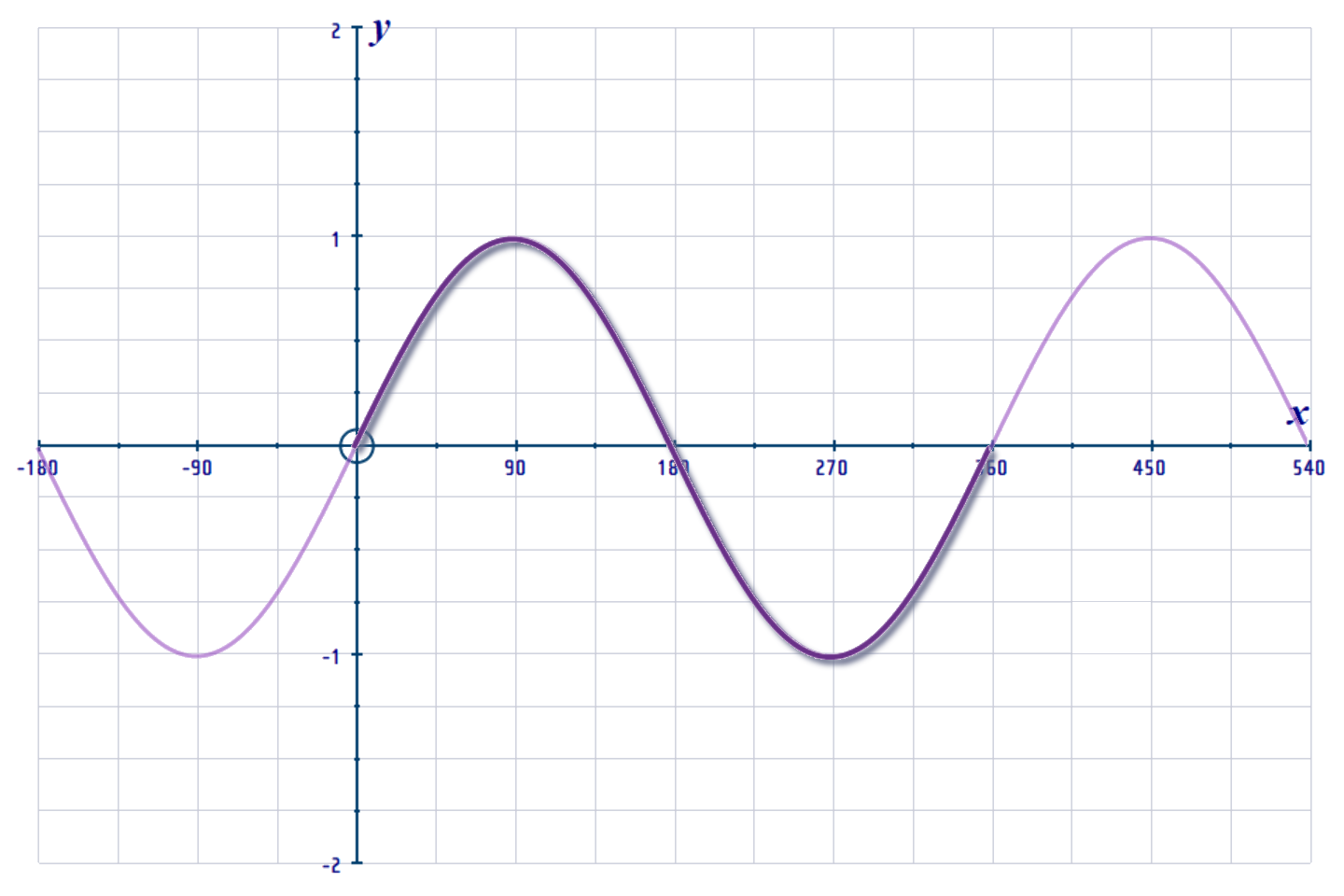
As in the WEB-LESSON, when performing TRANSFORMATIONS, but is a good idea to start with one cycle of the curve of \(y=\sin x\) (as shown below):
By using the same methods as in the movie, sketch the following curves. Use squared or graph paper and use a different grid for each curve:
For each question, you must:
- State clearly the transformations you have made
- Identify where the roots (0, 0), (180, 0) and (360, 0) have moved to...
- Identify where the turning points (90, 1) and (270, -1) have moved to...
[these are the ‘bounds’ (highest and lowest y-values)]
Question 5: Sketch: \(y=1+\sin \left( x-30 \right) \)
Clue:

In the Web Lesson, I didn't start with a flow diagram - but in these hints (and in your workings)
I wanna see a FLOW-DIAGRAM:

                    y  =  1 + sin(x - 30)
                          ▲           ▲
                          └───────────│─────────────────┐
                     ┌────────────────┘                 │
                     │                                  │
                   ┌─┴─┐                              ┌─┴┐
      x ──────────►│-30│───────────► RECIP ──────────►│+1│
                   └─┬─┘            └──┬──┘           └─┬┘
                     │                f(x)              │
                     └──┐                               └──────┐
                 ┌──────┴────────────────┐                     │
                 │ ‘-30’ is before f(x): │                     │
                 │TRANSLATE ‘-30’ ALONG x│       ┌─────────────┴───────┐
                 └───────────────────────┘       │ ‘+1’ is after f(x)  │
                                                 │TRANSLATE ‘⍰’ ALONG y│
                                                 └─────────────────────┘

One cycle of the  y = sin x  graph starts at (0, 0), crosses the x-axis at (180, 0)
and ends at (360, 0); these are its ROOTS
so label where these points have moved to:
ROOTS:

      y = sin x:        (0, 0), (180,0) and (360, 0)   	──┐
                                                       	  ├── +30 to the x-values
      y = sin(x-30):    (30, 0), (⍰, 0) and (390, 0) 	◄─┤
                                                       	  ├── +1 to the y-values
      y = 1+sin(x-30):  (30, ⍰), (⍰, ⍰) and (390, ⍰)	◄─┘

And the TURNING POINTS:

      y = sin x:        (90, 1) and (270, -1) 	 ──┐
                                              	   ├── +30 to the x-values
      y = sin(x-30):   (120, 1) and (300, -1) 	 ◄─┤
                                              	   ├── +1 to the y-values
      y = 1+sin(x-30):  (⍰⍰, ⍰) and (300,  ⍰)	─┘

So: ymax is 2 and ymin is 0 (these are called the ‘bounds’ of the curve)
Question 6: Sketch: \(y=1-\sin \left( x+90 \right) \)
Clue:

Re-write so the term with ‘x’ is on the left:

                    y  =  1  - sin(x+90)
                        ╘═╦╛╘═══╦═══════╛
                          ║  ╔══╝
                          ╚══╫═════════╗
                         ╒═══╩══════╕╒═╩═╕
                    y  =  - sin(x+90) + 1
                         └┬┘└─┬┘ └─┬┘└─┬─┘
                          ② f(x)  ①  ③
             ┌────────────┘        │   └──────────────┐
             │                     │                  │
             │       ┌─────────────┴──────────────┐   │
             │        "+90" is INSIDE the brackets    │
             │         Translate by ⍰⍰ along x      	│
             │                                        │
 ┌───────────┴─────────────────┐                      │
  "×-1" is OUTSIDE the brackets                       │
  Reflect in the x-axis                     ┌─────────┴───────────────────┐
                                             "+1" is OUTSIDE the brackets
                                             Translate the by ⍰⍰ along y


1-cycle of the y = sin x graph has roots at (0, 0), (180, 0) and (360, 0);
so label where these points have moved to:

y = sin x has turning points at: (90, 1) and (270, -1): Show where these have moved to

ymax is … and ymin is … (these are called the ‘bounds’ of the curve)
Question 7: Sketch: \(y=2+\sin \left( -x+60 \right) \)
Clue:

The FLOW-DIAGRAM looks like this:

      x ──────────► ×-1 ───────────► +60 ───────────► sin ──────────► +1
                   ╘══════════╤═════════╛            └─┬─┘
                              │                       f(x)
              ┌───────────────┴────────────────┐
           ┌──┘ You can see that there are TWO └──┐
┌──────────┤ transformations INSIDE the brackets! │
│          └──────────────────────────────────────┘
│
└───────► There is an ISSUE when we have MULTIPLE transformations INSIDE the brackets!
          FOR NOW - WE WILL SIMPLY ⛔ BAN ⛔ it (later, we'll learn how to deal with it!
                                  └────┬────┘
            ┌──────────────────────────┴──────────────────────────┐
            │ How can you answer the question if we've BANNED it? │
            └─────────────────────────────────────────────────────┘

Well -we need to go back to a simple RULE that we learnt a while back...

OKAY: We wanna RE-WRITE:  1 + sin (-x+60)

We learnt that SINE is an ODD function:   f(-x) ≡ -f(x)
                                            ▲     ▲
                                ┌───────────┘     └────────────┐
                   ┌────────────┴───────────┐                  │
                 ┌─┘ multiplying everything └──┐        ┌──────┴──────────┐
                 │ inside the brackets by ‘-1’ ├───►►───┤ Is the same as: │
                 └─────────────────────┬───────┘        │ THROWING a ‘-1’ │
                                       │                └─┐ in-front of ┌─┘
                                       │                  └───┐ the ┌───┘
                                       │                      │ SIN │
                                       │                      └──┬──┘
                                  ┌────┴────┐             ┌──────┴────┐
                         SO:       sin(x-60)    ≡          -sin(-x+60)
                                      └─┬──┘               ▲
                                        │                  └──────┐
                              ┌─────────┴─────────┐     ┌─────────┴─────────────────┐
                              │Here, I multiplied │     │Here, I left the INSIDE of │
                              │INSIDE the brackets│     │the brackets alone, but put│
                              └─────┐ by -1 ┌─────┘     │a ‘-1’ in-front of the SIN │
                                    └───┬───┘           └─────────┬─────────────────┘
                                        └─────────┐×-1            │×-1
                                 ┌────────────────┼───────────────┘
                           ┌─────┴────┐      ┌────┴─────┐
Which means we can REPLACE ‘sin(-x+60)’ with ‘-sin(x-60)’


Having re-written it - we can now proceed as usual!
Question 8: Sketch: \(y=2-\sin \left( -x+90 \right) \)
Clue:

Sorry, I cannae help yu - but I've put an applet for you to check your working…
An unknown function:
Below is a graph of \(y=f\left( x \right) \):
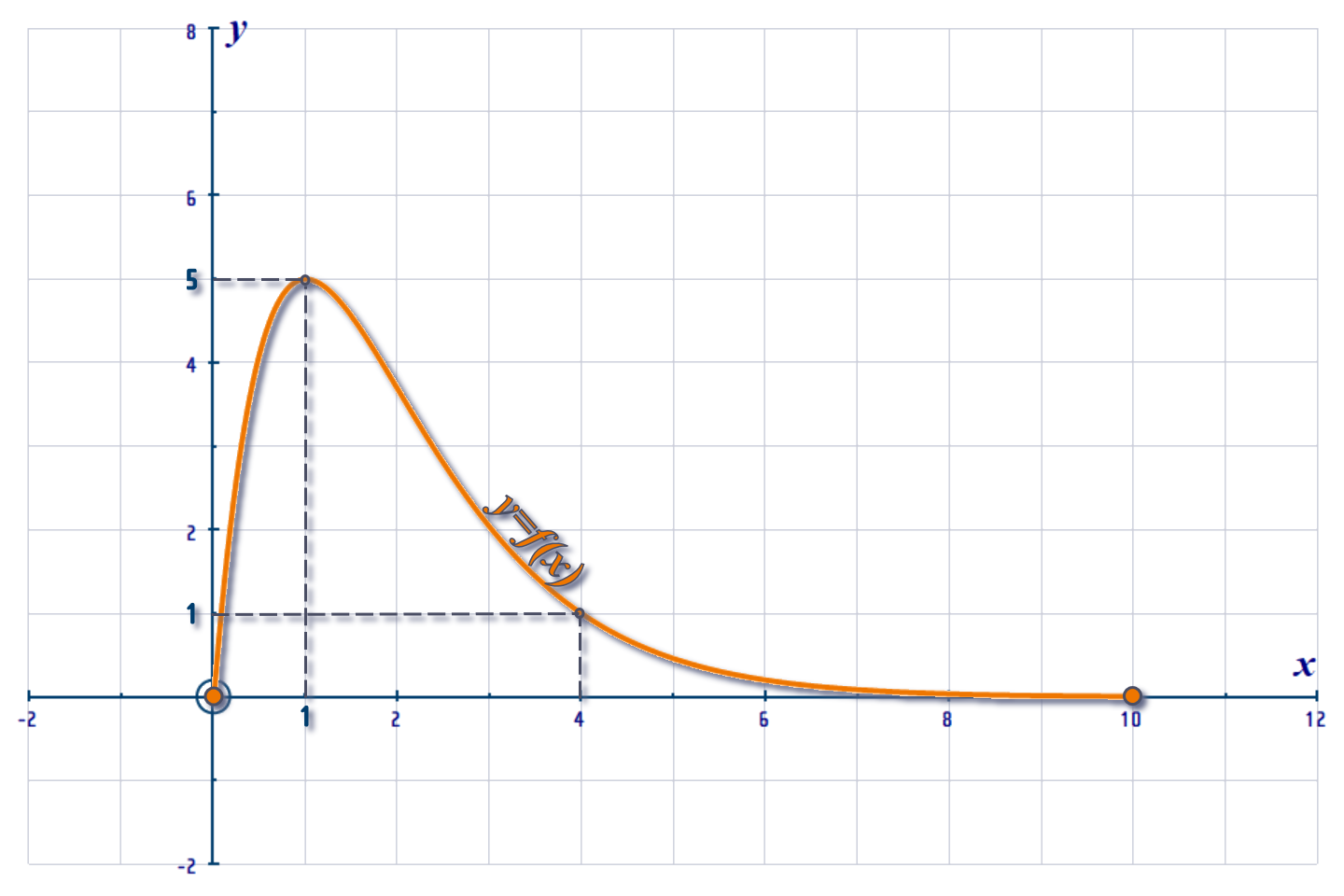
We are NOT told its equation: But we do know that \(f\left( x \right) \) is defined for \(0\leqslant x\leqslant 10\) and it has a root at \(x\,=\,0\) and another root at \(x\,=\,10\). The maximum point \(P\) is at \(\left( 1,5 \right) \).
It passes through the point \(Q\,=\,\left( 4, 1\right) \) and its gradient at \(Q\) is \(-\frac{3}{4}\)
The RANGE of \(y=f\left( x \right) \) is: \(0\leqslant yx\leqslant 5\)
Armed with this information about \(f\left( x \right) \) and the curve of \(y=f\left( x \right) \) (as shown above) and by using the same methods as in the movie, sketch the following curves.
Use squared or graph paper and use a different grid for each curve:
For each question, you must:
- State clearly the transformations you have made
- State the domain for which the transformed curve should be defined. Also state its range
- Identify the point \(P'\) (where \(P\,=\,\left( 1,5 \right) \) is on the transformed curve); and if \(P'\) is a maximum point
- Identify \(Q'\) (where \(Q\,=\,\left( 4,1 \right) \) is on the transformed curve); and state the gradient at \(Q'\)
- Identify where the points \(\left( 0,0 \right) \) and \(\left( 10,0 \right) \) have moved to; and determine if they are STILL roots
- Do you know the roots or the y-intercept of the transformed curve?
Question 9: Sketch: \(y=5\,-\,f\left( x+1 \right) \). You MUST state: (i) the domain, (ii) the range, (iii) \(P'\) (is it a still max?), (iv) \(Q'\) (and the gradient at \(Q'\)). PHEW!
Clue:

The FLOW-DIAGRAM is:

      x ──────────► +1  ───────────► f(x)  ──────────► ×-1 ──────────► +5
                   └─┬┘                               └─┬─┘           └─┬┘
                     ①                                 ②              ③
          ┌──────────┴──────────┐                       │               │
           ‘+3’ is before f(x):                         │               │
          TRANSLATE ‘-3’ ALONG x           ┌────────────┴─────┐         │
                                           ‘×-1’ is after f(x)          │
                                            REFLECT IN x-AXIS      ┌────┴────┐
                                                                    BLAH-BLAH

Don't forget: You got to locate the points P’ and Q’ AND you gotta give the gradient at Q’
Question 10: Sketch: \(y=1\,-\,f\left( 4-x \right) \). You MUST state: (i) the domain, (ii) the range, (iii) \(P'\) (is it a still max?), (iv) \(Q'\) (and the gradient at \(Q'\)). PHEW!
Clue:

This is TRICKY. The problem we encountered in QUESTION 7 has RESURFACED!

In QUESTION 7, we used a workaround (we knew y = sin x is an ODD function, so we could re-write it)

But this time, we don't have that luxury!

So we need to find the SOLUTION to the "MULTIPLE TRANSFORMATIONS IN THE BRACKETS problem:

      x ────────► ×-1 ─────────► +4 ─────────► f(x) ────────► ×-1 ────────► + 1
                 ╘═════════╤════════╛
                           │
           ┌───────────────┴────────────────┐
        ┌──┘ You can see that there are TWO └──┐
        │ transformations INSIDE the brackets! │
        └──────────────────┬───────────────────┘
                           │
Well - the SOLUTION IS SIMP│E, you just REVERSE the order of those TWO:
                           │
                 ┌─────────┴───────┐
      x ────────► ×-1 ─────────► +4 ─────────► f(x) ─────────► ×-1 ────────► + 1
                 ╘═╤═╛         ╘═╤═╛                          ╘═╤═╛         ╘═╤═╛
                   │             ①                           	│             │
                   │                                          	│             │
                   ②                                          	│             │
                                                                │             │
                                                               ③            	│
                                                                              │
                                                                             ④
Here's an applet for you to check!
Complete this web lesson on separate paper from any other homework
The pass mark (to avoid additional homework on this topic) is: 8/10
Show full workings and highlight your answers
|
|