Exercise 10.9Complex NumbersComplex Roots: the general case
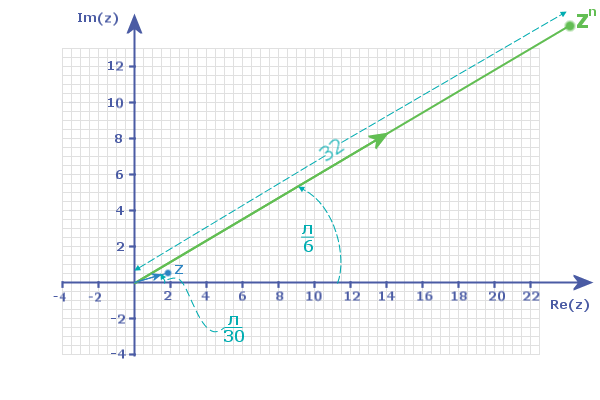
It looks complicated, but it's actually very easy to apply, in practice:e.g. Solve: ${ z }^{ 5 }\; =\; 32cis\left( \frac { \pi }{ 6 } \right)$The number we want to FIFTH-ROOT has a modulus of 32 and an argument of ⅙л: All the answers will have a modulus of 5√32 = 2 The first answer will have an argument of л/6 ÷ 5 = л/30
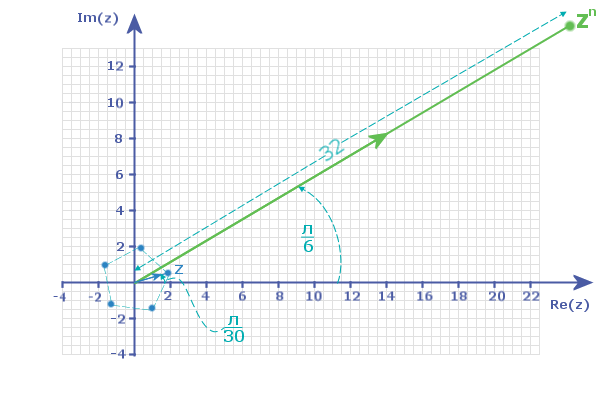
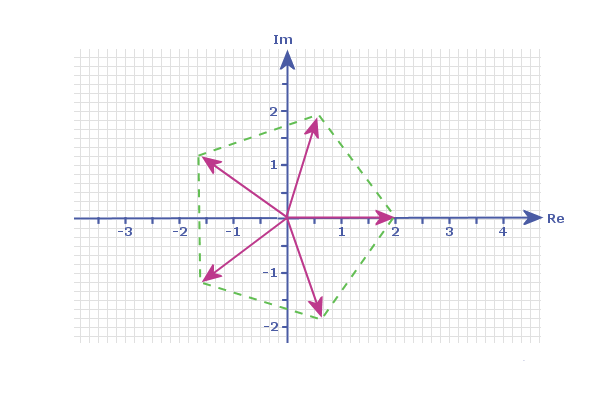
The other four answers and this one form a regular pentagon (so the each root is 72° (⅖лc)from the previous root):
So, the values of z are: 2 cⅈs л/30, 2 cⅈs 13л/30, 2 cⅈs 5л/6, 2 cⅈs -11л/30, 2 cⅈs -23л/30
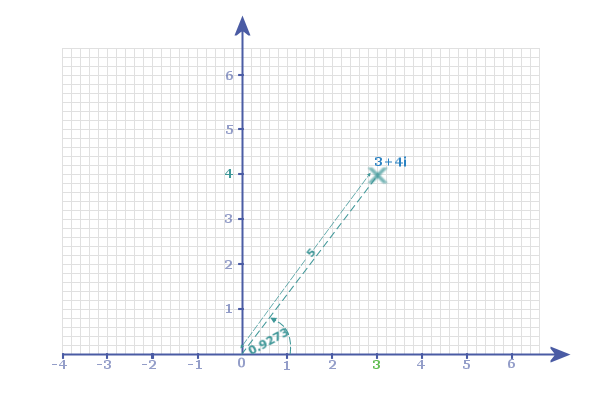
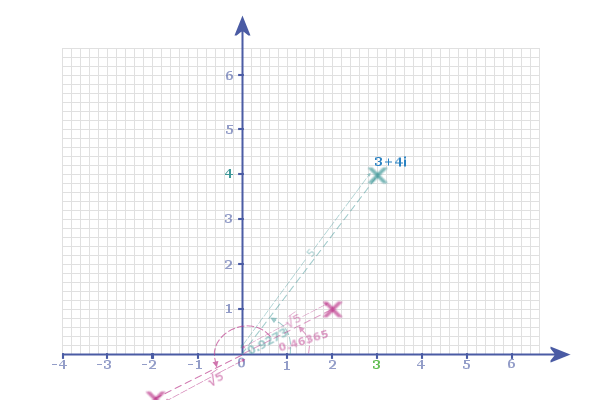
e.g. Solve: z5 = 16√3 + 16ⅈIt doesn't look like it, but actually this is the same question as the one above - but first you have to rewrite 16√3 + 16ⅈ in polar form and then it becomes obvious that is is the same question... The key being, to use this method to find square-roots, cube-roots etc, you have to first write the number in POLAR FORM... Question 1, part (a): Do you remember how we had to find the square-root of a complex number, back in ex 10.1 (qu 8), when we'd only just started learning about complex numbers... (We had to start by saying: √3+4ⅈ = a + bⅈ, then square both sides, then equate real and imaginary coefficients, solve the quartic to find a and b, then go for a lie down!) But because of de Moivre's Theorem, the whole thing becomes so much easier... 1) Convert 3 + 4ⅈ into polar form (your calculator can do that: Put it in complex mode, then type 3 + 4ⅈ then [shift][2][3] = to get 5∠0.9273 (which is the same as 5cⅈs0.9273)
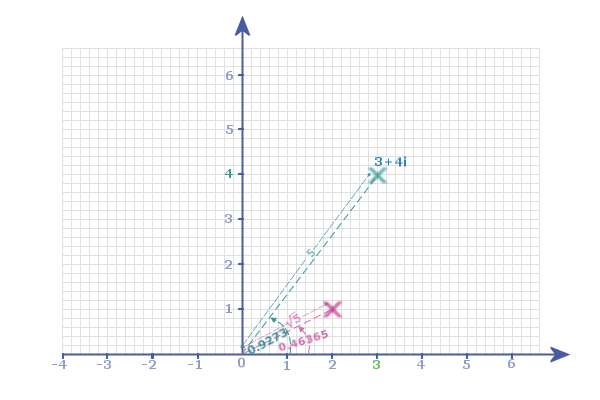
2) When we square-root a number, its modulus (in this case, 5) gets square-rooted, but its argument (in this case, 0.9273) gets halved:
3) So, we have the answer (in POLAR FORM): √5∠0.46365 , and the calculator will happily convert that to RECTANGULAR FORM: [shift][2][3] = to get 2 + ⅈ 4) This is the first answer to z² = 3 + 4ⅈ. The second answer is found by rotating this answer by л (180°):
Note: Before, as a sad little A-level student, you'd have said the second answer is the negative of the first answer (it still is), but now it is better for us to think of it as a rotation of 180°; because, when we come to CUBE-ROOT, we'll say the other two answers are found by rotating by 120°; so our line of thinking will be consistent...
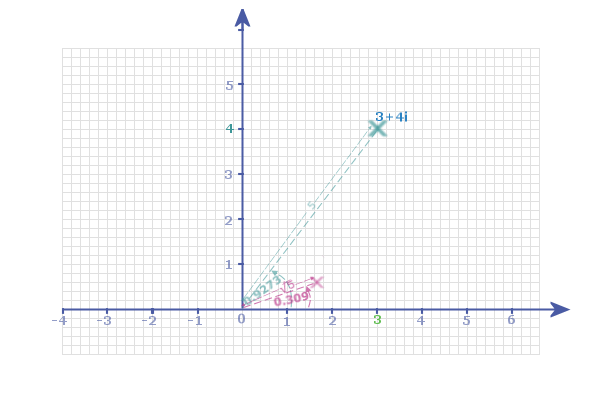
Question 2, part (a): Following almost exactly the same steps as in question 1: Step 1) Convert 3 + 4ⅈ into polar form (your calculator can do that: Put it in complex mode, then type 3 + 4ⅈ then [shift][2][3] = to get 5∠0.9273 (which is the same as 5cⅈs0.9273)
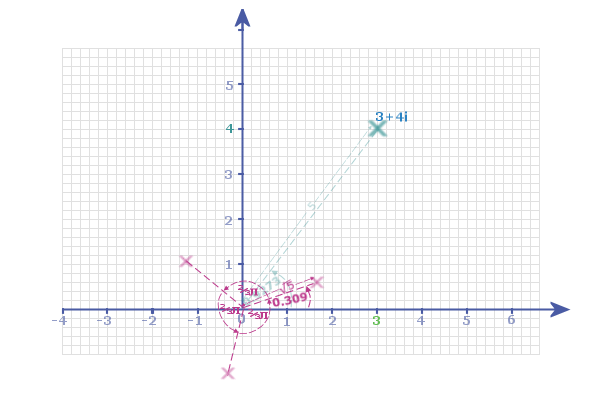
Step 2) When we CUBE-ROOT a number, its modulus (in this case, 5) gets cube-rooted, but its argument (in this case, 0.9273) is divided by 3:
Step 3) So, we have the answer (in POLAR FORM): ∛5∠0.309 , and the calculator will happily convert that to RECTANGULAR FORM: [shift][2][3] = to get 2 + ⅈ 4) This is the first answer to z³ = 3 + 4ⅈ. The second answer is found by rotating this answer by ⅔л (120°):
Note: Multiplying by ω { = cⅈs(⅔л) = ½(-1+√3ⅈ) } also achieves a rotation of 120°; so (if you want so STAY CARTESIAN after finding the first answer), you can also find the second answer by multiplying the first answer (2+ⅈ) by ½(-1+√3ⅈ)
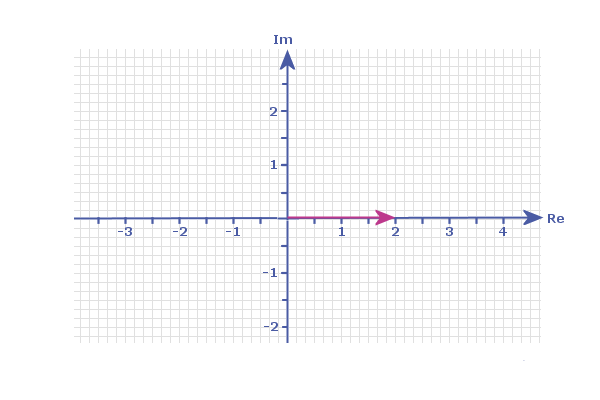
Question 3, part (a): Of course, we already know one cube-root of 32, it's 2...
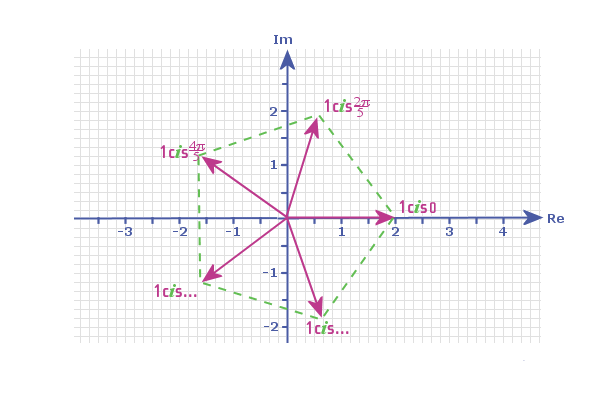
Remember the real number ‘2’ is the same as the complex 2cⅈs0 This answer, together with the other 4 answers will form a PENTAGON, which sort of looks like this:
And that means, in POLAR FORM, the answers are easy to write down; each one is a rotation of 2л/5 (72°):
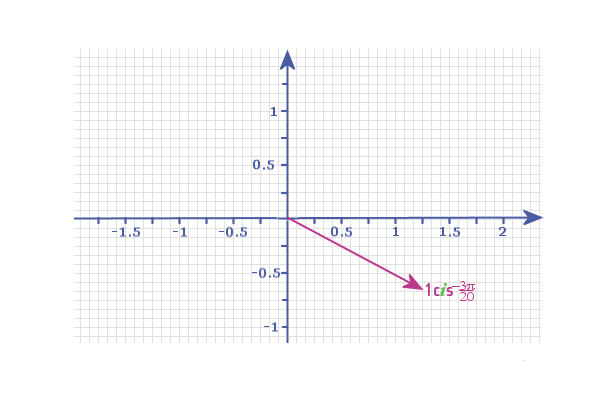
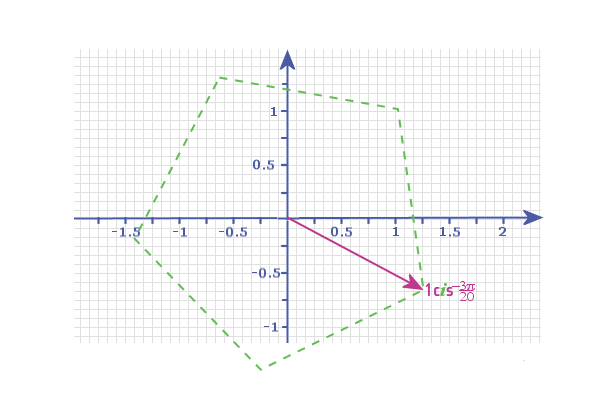
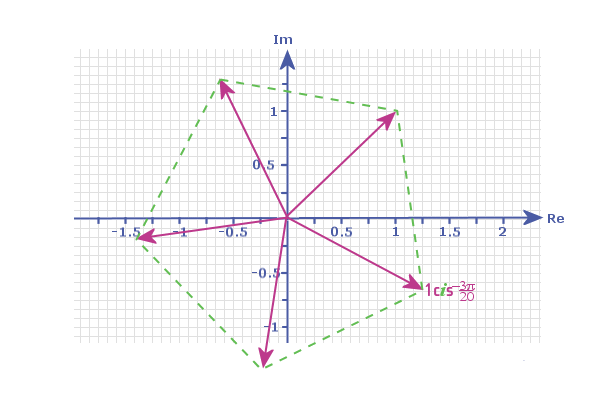
Question 3, part (b): Unlike the last question, this time, what we need to do is to find the first answer (then the other answers will simply be placed so as to form a pentagon, starting from the first answer...) So, the first thing we should do is to convert -4 ─ 4i into polar form: R = √32 and θ = -¾л So: 5√-4 ─ 4ⅈ is the same as {√32 cⅈs(-¾л)}⅕ So, the modulus gets fifth-rooted: R ──> √2 And the argument gets divided by 5: θ──> -3л/20 So, the FIRST solution is: √2 cⅈs(-3л/20), which looks like this:
And again, the other answers will be spaced nicely around this:
And so, these are the answers...
We can find them in POLAR FORM easily (and then convvert them to Cartesian form if we want to...)
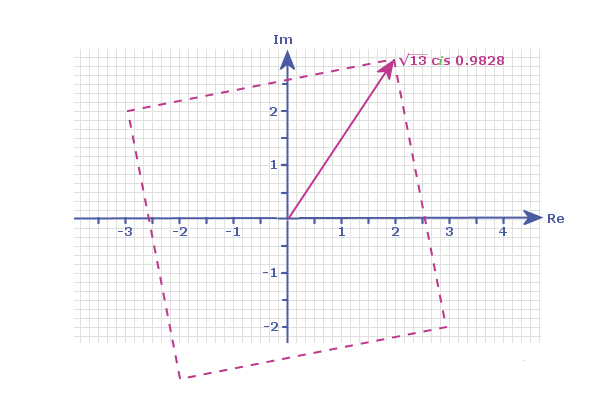
Question 4: Actually, this is easier than the last question - because we already know where one of the answers lies... And since all FOUR answers must be equally spaced around, the remaining answers must look like this:
Question 7: We solved these type of questions right at the start of the AS course - remember that? It's easy, you have to use substitution; U = z³ Then its easy to solve (even though it does give complex solutions...) But, you have to substitute back; so you'll get: z³ = 2+2ⅈ and z³=2-2i; and each of those CUBE-ROOTS will give three possible answers... (Anyway, that's not too hard, because you did CUBE-ROOTS of 2-2i in question 2, part (d)...)
Question 8, part (a): So, we want to use CARDANO's lovely formula (that he hardly at all stole from Tartaglia) to solve a depressed cubic (it's not unhappy, it just doesn't have an ${ z }^{ 2 }$ term): ${ z }^{ 3 }+pz+q\;=\;0$ $$z\; =\; {\underbrace { \sqrt [ 3 ]{ -\frac { q }{ 2 } +\sqrt { \frac { { q }^{ 2 } }{ 4 } +\frac { { p }^{ 3 } }{ 27 } } } }_{A}} \; +\; {\underbrace {\sqrt [ 3 ]{ -\frac { q }{ 2 } -\sqrt { \frac { { q }^{ 2 } }{ 4 } +\frac { { p }^{ 3 } }{ 27 } } } }_{B}}$$ Now, when we do the cube-roots, we have to use the same method as we used in question 2 (i.e. find all three solutions...) That means that, even for a cubic where all three solutions are real; we'll have to go through the complex world to get to the answers! So, to solve: z³ - 24z - 56 = 0 └─┬──┘└──┬─┘ p q In this case; plugging in p = -24 and q = -56, into the discriminant, we get: q² + p³ = 1296 4 27 └─┬──┘ └──┬─────┘ └───── if it's +VE, that means we'll get This is called the discriminant ───┘ ONE real and TWO complex answers So, we need to find the solutions to ³√28+36 + ³√28-36: (i.e. ³√64 + ³√-8) Starting with ³√64 : 1st answer = 4 (obvious - let's call this answer α) 2nd answer = -2+2√3ⅈ (multiplying the 1st answer by ω, where ω = cⅈs(⅔л) = ½(-1+√3ⅈ) to rotate it 120°) 3rd answer = ……-……ⅈ (multiplied the 1st answer by ω², to rotate it 240°) Next, moving on to the next cube-root ³√-8: 1st answer = -2 (obvious, let's call this answer β) 2nd answer = 1-√3ⅈ (Multiplying the 1st answer by ω, where ω = cⅈs(⅔л) = ½(-1+√3ⅈ) to rotate it 120°) 3rd answer = ……+……ⅈ (Multiplied the 1st answer by ω², to rotate it 240°) Finally our answers are: ┌───────┐ α + β = 4 + -2 = │ 2 │ ωα + ω²β = -2+2√3ⅈ + …+…ⅈ = │ …+…ⅈ │ ω²α + ωβ = …-…ⅈ + 1-√3ⅈ = │ …+…ⅈ │ └───┬───┘ ┌───────────┴────────────┐ │ these are our three │ │ solutions to the cubic │ └────────────────────────┘ I hope you paid careful attention to the order there: 1st ans + 1st ans; 2nd ans + 3rd ans; 3rd ans + 2nd ans...
Question 8, part (b): This time, plugging in p = -78 and q = -220, into the discriminant, we get: q² + p³ = -5476 4 27 └─┬───┘ └──┬─────┘ └───── if it's -VE, that means all This is called the discriminant ────┘ THREE answers will be real So, we need to find the solutions to ³√ 110+74ⅈ + ³√ 110-74ⅈ └───┬───┘ └───┬───┘ notice these are now conjugates These are going to be a little bit more work than the last question; but we know how to do this... Starting with ³√ 110 + 74ⅈ : 1st answer = 5+ⅈ ( ─►─ Polar √26³cⅈs0.592…, ³√modulus & arg÷3: √26cⅈs0.197… ─►─ Cartesian) 2nd answer = ……+……ⅈ (multiplying the 1st answer by ω, where ω = cⅈs(⅔л) = ½(-1+√3ⅈ) to rotate it 120°) 3rd answer = ……-……ⅈ (multiplied the 1st answer by ω², to rotate it 240°) Next, moving on to the next cube-root ³√ 110 - 74ⅈ : 1st answer = 5-ⅈ (obviously, it's the conjugate of 100 + 74ⅈ so the cube-root is also the conjugate)
2nd answer = ……+……ⅈ (Multiplying the 1st answer by ω, where ω = cⅈs(⅔л) = ½(-1+√3ⅈ) to rotate it 120°)
3rd answer = ……+……ⅈ (Multiplied the 1st answer by ω², to rotate it 240°)
Finally our answers are: ┌───────┐ α + β = 5+ⅈ + 5-ⅈ = │ 10 │ ωα + ω²β = ……+……ⅈ + ……+……ⅈ = │ …… │ ω²α + ωβ = ……-……ⅈ + ……+……ⅈ = │ …… │ └───┬───┘ ┌───────────┴────────────┐ │ these are our three │ │ solutions to the cubic │ └────────────────────────┘ Don't forget to check!
Question 8, part (c): They tell us to let u = x - r: (x-r)³ - 6(x-r)² + 36(x-r) - 112 = 0 That's a bit messy to expand (we can't do it, we ain't scared), but really, we just need to figure out the x² term: The x² term of: (x-r)³ ─────► -3r x² The x² term of: (x-r)² ─────► 1 x² The x² term of: (x-r) ─────► none The x² term of: -112 ─────► none The x² term of: (x-r)³ - 6(x-r)² + 36(x-r) - 112 = 0 ─────► (-…r - …)x² We want the x² term to be zero, which means p = ... Okay, so now we can do the substitution, solve and then substitute back - easy-peasy...
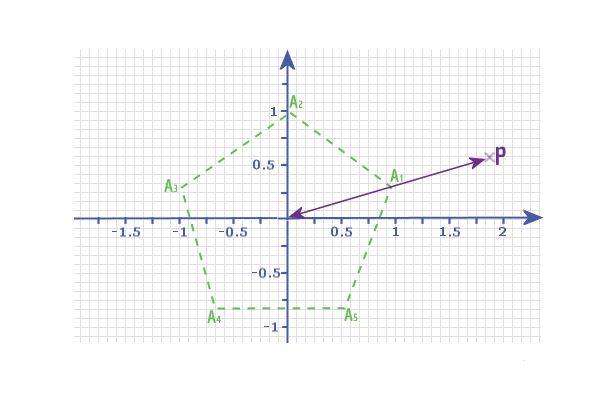
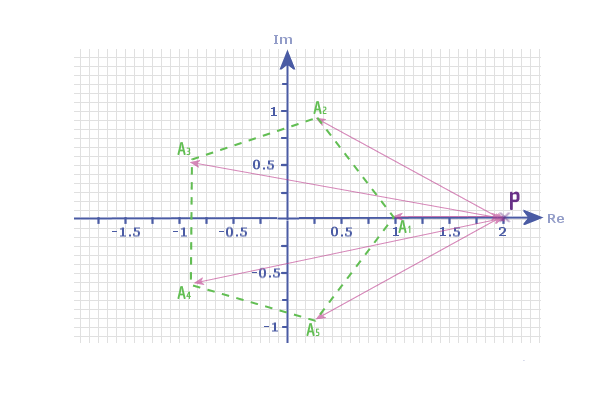
Question 10, part (a): So, we have a pentagon (drawn in a circle of radius 1); so that means OA1 = 1 unit; and since OP is twice as big, we can say OP = 2 units:
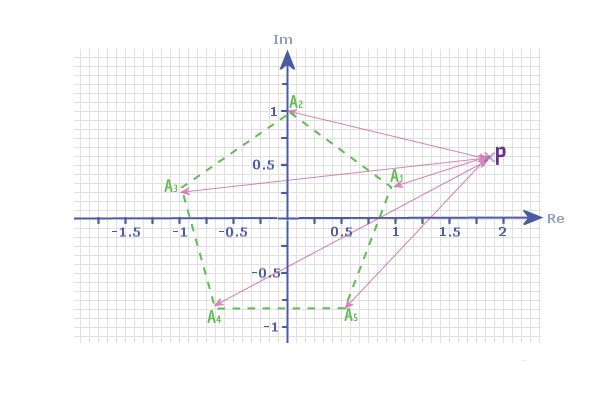
And we want to figure out what the answer is if we multiply all of these lengths together:
But, if I rotate the diagram slightly, so that A1 lines up with the real axis (i.e. A1 = 1+0ⅈ and P = 1+0ⅈ), it doesn't affect any of the lengths, so it doesn't affect the answer...
In which case, A1, A2, A3, A4 and A5 are the fifth roots of unity (1, ω, ω2, ω3 and ω4) and P is the number 2 + 0ⅈ In which case, the vector PA1 is: 1 So the product we require is: 1(ω - 2)(ω2 - 2)(ω3 - 2)(ω4 - 2) That's quite a messy expansion, so to make it easier, think in terms of how many '-2's are being multiplied together for each collection of terms: 1) Terms with no '-2's: ω10 Looking at (1), since we know that (by definition) ω5 = 1, this simplifies to: 1 Looking at (2) and simplifying: -2(ω4 + ω3 + ω2 + ω) Etc... Note: The method I've described is the easiest to understand, but the longest to apply!
Question 10, part (b): Basically, this means: |ω - 2|² + |ω2 - 2|² + |ω3 - 2|² + |ω4 - 2|² + |ω5 - 2|² We know from the property of conjugates that: zz* = |z|² So we can re-write this sum as: (ω - 2)(ω - 2)* + (ω2 - 2)(ω2 - 2)* + .......... And, from the distributive property of conjugates as: (ω - 2)(ω* - 2*) + .......... And, since 2* is still 2 and since ω* = ω4, as: (ω - 2)(ω4 - 2) + ..........
Question 10, part (c): This time, they want: (ω - 1)(ω2 - 1)(ω3 - 1)(ω4 - 1)
Question 11: This provides a much better route to answering question 9: We know that the roots of zn - 1 = 0 are: 1, ω, ω2, ..., ωn-1 We also know that: 1 + ω + ω2 + ... + ωn-1 = 0 So an equivalent equation such as: 1 + z + z2 + ... + zn-1 = 0; must have roots: ω, ω2, ..., ωn-1 And so must the equation: (z - ω)(z - ω2)(...)(z - ωn-1) = 0
Question 13: By convention; ωm/n is taken to mean the nth root of ωn - only be adhering to this mathematical order, can we ensure that de Moivre's theorem holds true for rational powers...
Question 14: Replace the √-1 with ⅈ and replace the ∞ with \(n\) - and use limits: \[\lim _{ n\rightarrow \infty }{ \left[ \frac { 2n }{ i } \left\{ { \left( 1+i \right) }^{ 1/n } \;-\;{ \left( ........ \right) }^{ ...... } \right\} \right] } \] Now, you can't apply de Moivre's Theorem unless those exponentials are written in polar form. After that - is should be copacetic... p.s. In case I haven't already taught you; the small angle approximations (when θ is measured in radians) are: sin θ ≈ θ and cos θ ≈ 1 - ½θ². Try them out for yourself; for (say) sin 0.012c and cos 0.012c
|