Web Lesson #44 Linear Algebra
› › › Matrices & Transformations
The Interactive Web-Lesson below has questions embedded
So do it carefully, as your answers are sent to me!
- When a question pops up, if you want to see the movie again, click ‘ 🅷🅸🅳🅴 ’ (in the top right corner)
- You CAN'T retry a ‘flopped’ question: So 𝓟𝓐𝓨 𝓒𝓛𝓞𝓢𝓔 𝓐𝓣𝓣𝓔𝓝𝓣𝓘𝓞𝓝 and 𝓽𝓱𝓲𝓷𝓴❗
- When you answer a question 𝒄𝒐𝒓𝒓𝒆𝒄𝒕𝒍𝒚, you'll usually get a chance to 𝐒𝐊𝐈𝐏 the explnation - but be quick!
- Anytime you click on the © 2023 Math'scool you'll skip back to the previous section...
Matrices & Transformations:
▪
A matrix is really just a table of numbers:
So, if we have a table showing the results of two football teams at a certain stage in the 2023 season, like this:
2023
Man U
Man C
Win
15
23
Draw
8
2
Lose
6
5
We might represent it with a matrix like this: \(\begin{matrix}\,\,& \begin{matrix}\tiny{W}& \tiny{D}& \tiny{L}\\\end{matrix}\\\begin{array}{c}\tiny{\text{Man U}}\\\tiny{\text{Man C}}\\\end{array}& \left( \begin{matrix}15& 8& 6\\23& 2& 5\\\end{matrix} \right)\\\end{matrix}\)
Although unlike the table, the matrix won't actually have headings for the row/columns, so it would actually be given like this:
\(\left( \begin{matrix}15& 8& 6\\23& 2& 5\\\end{matrix} \right) \)
(So, we'd have to know beforehand what the rows/columns in the matrix stand for...)
▪
We might decide to compare that with last year's results at the same stage of the season: \(2022 = \left( \begin{matrix}14& 8& 8\\16& 9& 4\\\end{matrix} \right) \)
▪
Matrices are also used to represent vectors. So, if we have these a quadrilateral with these 4 points as vertices (corners):
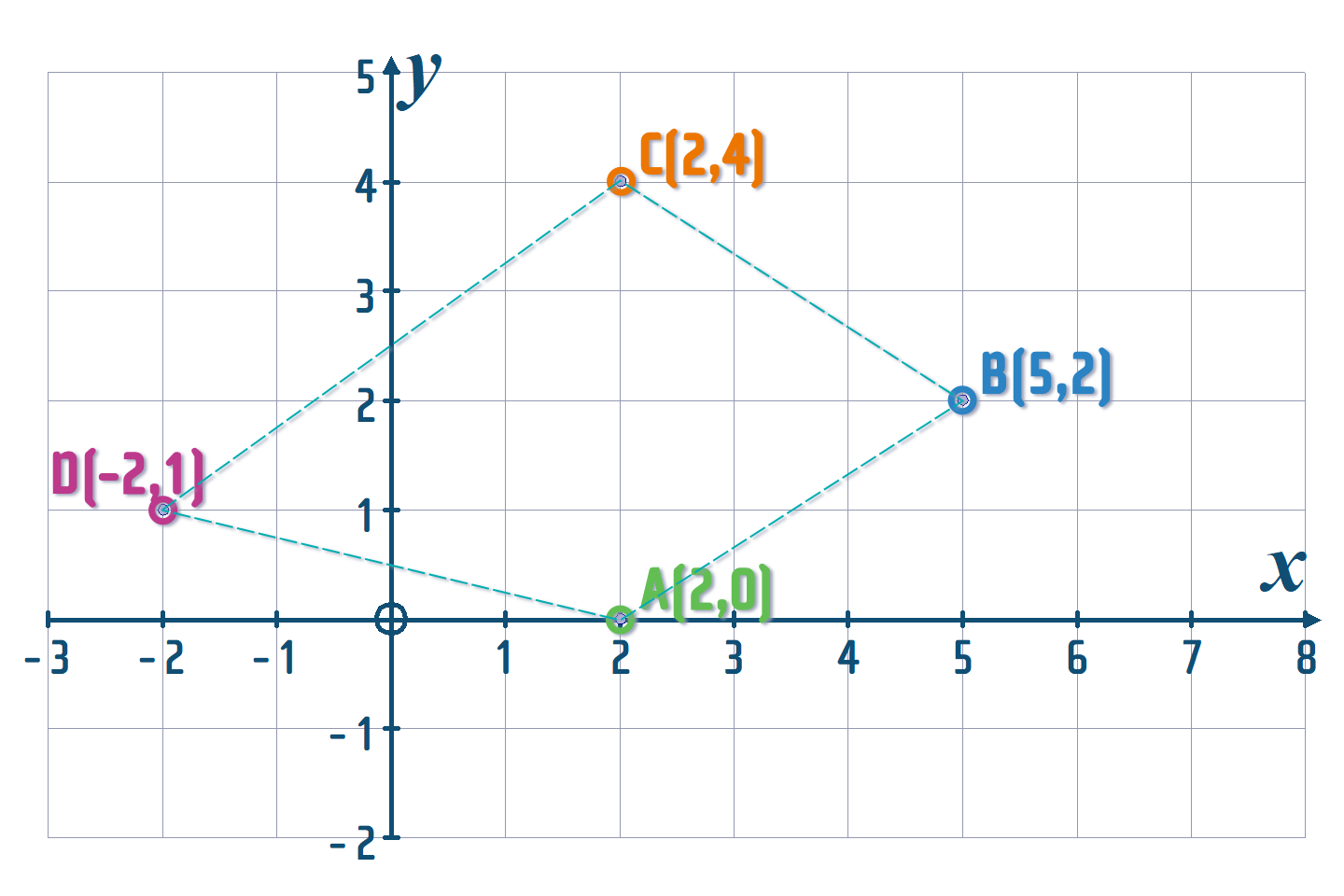
Then we like to talk about the vectors from the origin to each point as the position vector of that point:
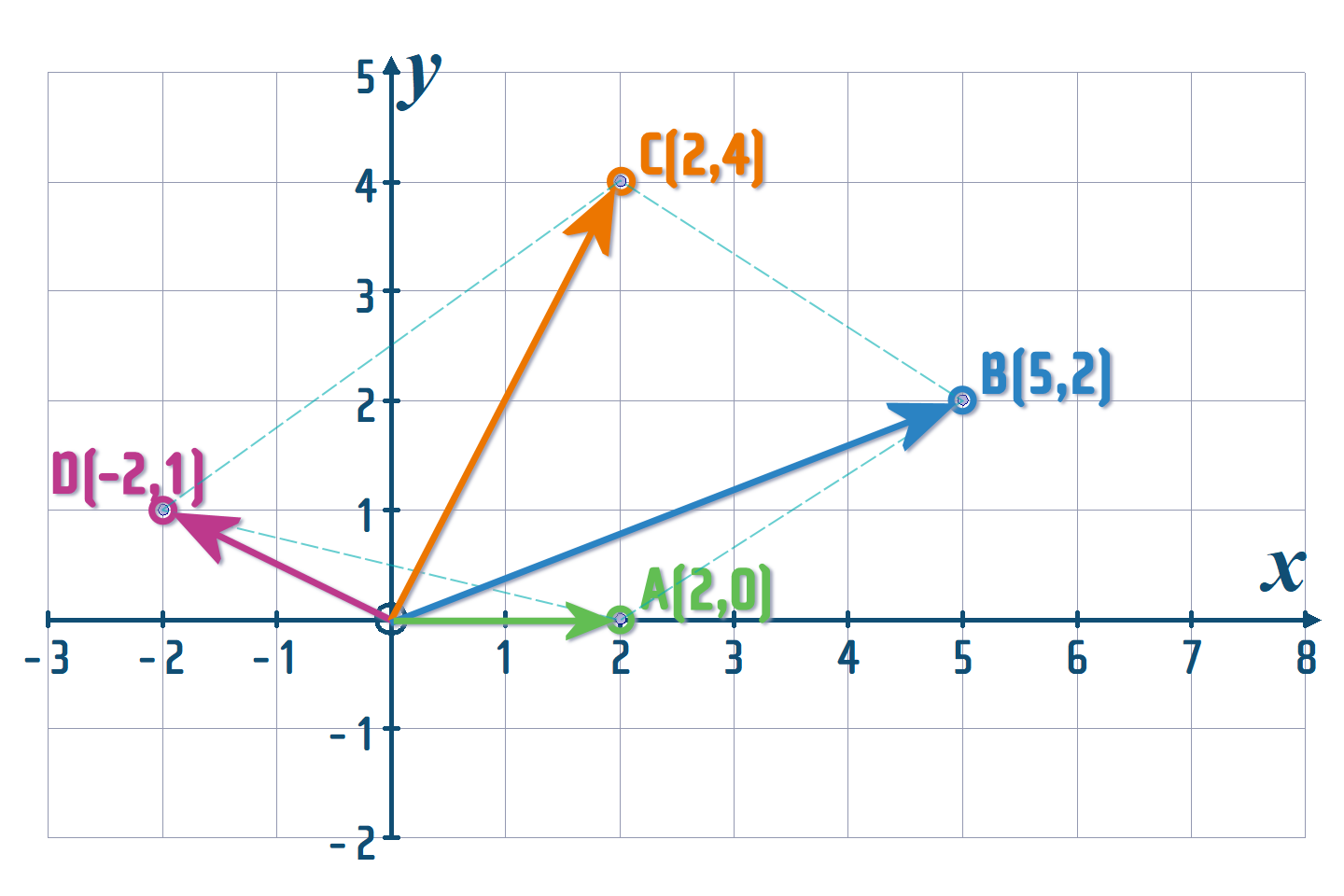
It's really a pedantic (fussy) difference, but the coordinates of \(B\) are: \(\left( 5, 2 \right) \) whereas the position vector of \(B\) is: \(\left( \begin{array}{c}5\\2\\\end{array} \right) \)
So, we might group together all of the vertices of our quadrilateral into a matrix like this: \(\begin{array}{c}\begin{matrix}\tiny{A}& \tiny{B}&\tiny{C}&\tiny{D}\\\end{matrix}\\\left( \begin{matrix}2& 5&2&-2\\0& 2&4&1\\\end{matrix} \right)\\\end{array}\)
So, you can see, the points are represented by their column-vectors
                                                                         A   B   C    D
                                                                       ⎧ 2   5   2  -2 ⎫
                                                                       ⎩ 0   2   4    1 ⎭
Which explains why we need to start thinking of the coordinates of the point as the position vector (from the origin to the point)...
One of the big advantages of vectors and matrices is that the methods we use are easy to upgrade to 3-dimensions, whereas the Cartesian methods we learnt before go a bit messy when we move into 3D...
When we give the dimensions of a matrix, we state the number of rows, followed by the number of columns:
        ⎧1  2⎫                 ⎧2  0⎫ 	                ⎧3 -1  2⎫                ⎧5  2  0⎫
        ⎪4  6⎪                 ⎩0  2⎭ 	                ⎪0  1  1⎪                ⎩1  9  1⎭
        ⎩0  3⎭               └────┬───┘	                ⎪7  0  3⎪               └─────┬────┘
      └───┬────┘            2 × 2 matrix	              ⎩2 -3  6⎭              2 × 3 matrix
     3 × 2 matrix                                    └─────┬─────┘
                                                      4 × 3 matrix
The elements inside a matrix are referred to by using subscripts:
                           ⎧ A₁₁ A₁₂ A₁₃ A₁₄ ......A₁ₘ ⎫
                           ⎪ A₂₁ A₂₂ A₂₃ A₂₄ ......A₂ₘ ⎪
                           ⎪ A₃₁ A₃₁ A₃₃ A₃₄ ......A₃ₘ ⎪
                           ⎪ A₄₁ A₄₂ A₄₃ A₄₄ ......A₄ₘ ⎪
                           ⎪ A… A… A… A… ......A₄ₘ ⎪
                           ⎩ Aₙ₁ Aₙ₂ Aₙ₃        	 Aₙₘ  ⎭
▪
Matrix Addition / Subtraction
Matrices can be added/subtracted ONLY if they have the same dimensions
e.g. These two matrices CANNOT be added:
                ⎧ 4  5 ⎫  +  ⎧ 2  1  0 ⎫    ◄────────────── THESE CANNOT BE ADDED/SUBTRACTED
                ⎩ 3  1 ⎭     ⎩ 1 -2  1 ⎭
e.g. These two matrices CANNOT be added:
                ⎧ 1  4 ⎫  +  ⎧ 1  5  1 ⎫    ◄────────────	THESE CANNOT BE ADDED/SUBTRACTED
                ⎪ 2  3 ⎪     ⎩ 2  3  0 ⎭                  	But, as you saw in the movie
                ⎩ 6  2 ⎭                               	  they can be multiplied
e.g. These two matrices CAN be added:
                 ┌────────────┬─────────────┐
                 │  ┌─────────│──┬──────────│──┐
                ⎧ 4  5 ⎫  +  ⎧ 2  0 ⎫   =  ⎧ 6  5 ⎫
                ⎩ 3  ½ ⎭     ⎩ 1 -½ ⎭      ⎩ 4  0 ⎭
                 │  └─────────│──┴──────────│──┘
                 └────────────┴─────────────┘
▪
▪
Any matrix can be multiplied by a scalar - every element in the matrix is multiplied by the scalar:
e.g. This matrix is being multiplied by 4:
                                  ⎧ 1  0 ⎫                ⎧ 4  0 ⎫
                                4 ⎪ 2  ¼ ⎪        =       ⎪ 8  1 ⎪
                                  ⎩ ½  1 ⎭                ⎩ 2  4 ⎭
▪
Let's test your understanding
▪
Question 1: The matrices A, B, C, D and E are:
\(A = \left( \begin{matrix}1& 5& 0\\2& 1& 3\\\end{matrix} \right) \), \(B = \left( \begin{matrix}4& -3\\2& 1\\\end{matrix} \right) \), \(C = \left( \begin{matrix}1& 3\\2& 5\\1&4 \end{matrix} \right) \), \(D = \left( \begin{matrix}2& -1& 1\\3& 1& 0\\\end{matrix} \right) \), \(E = \left( \begin{matrix}1& 3\\2& 5\\\end{matrix} \right) \)
If possible work out:
a) \(A+B\)
b) \(B+E\)
c) \(C-A\)
d) \(2A-D\)
e) \(B-\frac{1}{2}E\)
Note: If any of the above are not possible, write "not possible" as your answer
▪
▪
Hints
Part (a): I'll give you some help, in the form of a limerick:
▪
▪
Matrix Multiplication (Non-commutativity)
An ‘a × b’ matrix (i.e. ‘a’ rows and ‘b’ columns) can be multiplied with a ‘c × d’ matrix if b = c
The resulting answer will be an ‘a × d’ matrix
The example given in the Web Lesson was:
                        ⎧ 4  1 ⎫          ⎧ 2  0  1 ⎫
                   A =  ⎪ 2  3 ⎪     B =  ⎩ 1  2 -1 ⎭
                        ⎩ 1 -1 ⎭
And we wanted to find the product: \(AB\)
                                               ┌──────────────────────────────────────┐
                          ┌──────────┬─────────┤ These dimensions HAVE to be the same │
                          ▼          │         └──────────────────────────────────────┘
                        ←←→→         ▼
                     ↑ ⎧4  1⎫        ↑ ⎧2  0  1⎫           ↑	⎧9  2  3⎫
                     3 ⎪2  3⎪    ×   ↓ ⎩1  2 -1⎭      =    3	⎪7  6 -1⎪
                     ↓ ⎩1 -1⎭           ←←←3→→→             ↓	⎩1 -2  2⎭
                     ▲                 └───┬───┘            ▲  ←←←3→→→
                     │                     │                │ └───┬───┘
                 ┌───┴─────────────────────┴────────────────┴─────┴────┐
                 │ These dimensions give the dimensions of the product │
                 └─────────────────────────────────────────────────────┘
Matrix multiplication is NOT commutative - so, in the case above, if they had asked us to find BA (i.e. they swapped the order around) the answer would be completely different:
                      ↑ ⎧2  0  1⎫      	⎧4  1⎫           ↑ ⎧9  1⎫
                    	↓ ⎩1  2 -1⎭   ×  	⎪2  3⎪     =     ↓ ⎩7  8⎭
                                       	⎩1 -1⎭              ←←→→
                     	                   ←←→→
Even the dimensions of the answer are different in this case!
So, in words, \(AB\) is pronounced, ‘\(A\) pre-multiplies \(B\)’
And \(BA\) is pronounced, ‘\(B\) pre-multiplies \(A\)’
In this case, \(AB\) and \(BA\) gave different answers...
...but in other cases, it won't even be possible to multiply the matrices if the order is swapped.
In a few cases (only for square matrices, and only sometimes) swapping the order makes no difference...
All in all, matrix multiplication is a lot more fun than normal multiplication...
▪
Question 2: The matrices \(A\), \(B\), \(C\), \(D\) & \(E\) are:
\(A = \left( \begin{matrix}1& 5& 0\\2& 1& 3\\\end{matrix} \right) \), \(B = \left( \begin{matrix}4& -3\\2& 1\\\end{matrix} \right) \), \(C = \left( \begin{matrix}1& 3\\2& 5\\1&4 \end{matrix} \right) \), \(D = \left( \begin{matrix}2& -1& 1\\3& 1& 0\\\end{matrix} \right) \), \(E = \left( \begin{matrix}1& 3\\2& 5\\\end{matrix} \right) \)
If possible work out:
a) \(CE\)
b) \(BE\)
c) \(EB\)
d) \(AB\)
e) \(BA\)
Note: For any of the above are not possible, write "not possible" as your answer for that part
▪
▪
▪
The Order of Matrix Multiplication (Associativity)
We discovered above that \(AB\) and \(BA\) ain't normally the same, which leads to an important question!
When we need to do TWO multiplications: ABC (i.e. \(A\color{#e54239}{\times} B\color{#e54239}{\times} C\)), should we find:
                                ABC  =  (AB)C      ???
                                        └─┬┘▲
                     ┌─────────◄──────────┘ └───────────────┐
        ┌────────────┴────────────┐             ┌───────────┴────────────┐
        │ Do we multiply AB first ├──────►──────┤ and then multiply by C │
        └─────────────────────────┘             └────────────────────────┘
Or, do they want us to find:
                                ABC  =  A(BC)      ???
                                        ▲└─┬┘
                     ┌──────────────────┘  └─────────►───────┐
        ┌────────────┴───────────┐             ┌─────────────┴────────────┐
        │ and then multiply by C ├──────◄──────┤ Do we multiply BC first  │
        └────────────────────────┘             └──────────────────────────┘
Well, perhaps we can try to discover the answer:
▪
▪
Question 3: The matrices \(F\), \(G\) and \(H\) are:
\(F = \left( \begin{matrix}1& 3& -1\\0& 1& 0\\\end{matrix} \right) \), \(G = \left( \begin{matrix}2& 1\\3& 1\\\end{matrix} \right) \), \(H = \left( \begin{matrix}1& -1&0\\2& -1&1\\0&0&1 \end{matrix} \right) \)\)
If possible work out:
a) \(G\left( FH \right) \)
b) \(\left( GF \right) H\)
c) \(\left( FH \right) G\)
d) \(F\left( HG \right) \)
e) What can you deduce about the order in which we perform the multiplication?
Note: For any of the above are not possible, write "not possible" as your answer for that part
▪
Hints
Sorry mate - I got things to do, places to go, people to meet - you carry on!
▪
Question 4: The matrices \(F\), \(G\) and \(H\) are:
\(F = \left( \begin{matrix}1& 3& -1\\0& 1& 0\\\end{matrix} \right) \), \(G = \left( \begin{matrix}2& 1\\3& 1\\\end{matrix} \right) \), \(H = \left( \begin{matrix}1& -1&0\\2& -1&1\\0&0&1 \end{matrix} \right) \)\)
If possible work out:
a) \(F^2\)
b) \(G^2\)
c) \(H^2\)
d) \(G^3\)
e) What can you deduce about when it is possible to find powers of matrices?
Note: For any of the above are not possible, write "not possible" as your answer for that part
▪
▪
▪
Matrices and Transformations
The movie also showed us that matrices can also represent TRANSFORMATIONS. For now, we will stick to 2 × 2 (square) matrices - because they represent transformations in 2-dimensions, so we can easily draw a graph to show the transformation...
The example in the movie was the matrix:
                                  M  =  ⎧ 2  0 ⎫
                                        ⎩ 0  1 ⎭
We wanted to discover what transformation was represented by this matrix. So, we started with a simple shape: A triangle with vertices A(3, 1), B(3, 0) and C(1, 0):
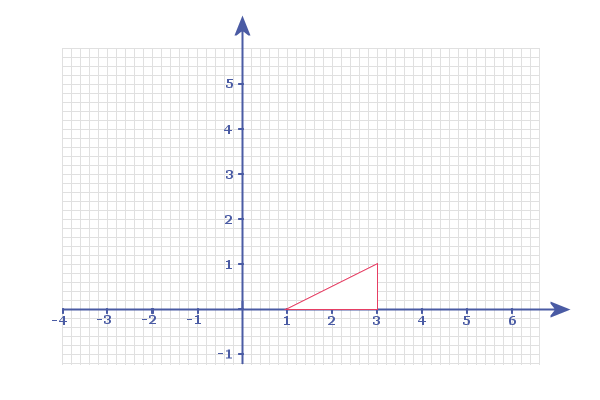
So, we put those vertices into a matrix:
                                   A  B  C
                                 ⎧ 3  3  1 ⎫
                                 ⎩ 1  0  0 ⎭
And then we multiplied the matrices, to find the transformed points A’, B’ and C’:
                   M
                 ┌──┴──┐              A  B  C                  A’ B’ C’
                ⎧ 2  0 ⎫     ×     ⎧ 3  3  1 ⎫        =      ⎧ 6  6  2 ⎫
                ⎩ 1  1 ⎭           ⎩ 1  0  0 ⎭               ⎩ 1  0  0 ⎭
▪
Finally, we plotted those on the same grid:
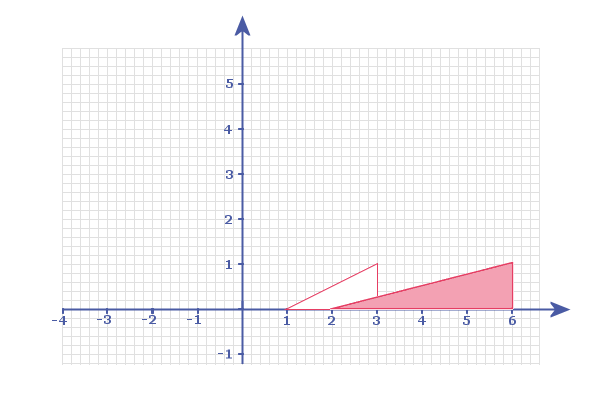
And realised the transformation was a "One-way Stretch (parallel to the x-axis) of scale factor ×2"
▪
▪
Question 5: By applying each transformation matrix (below) to the same triangle {A(3, 1), B(3, 0) and C(1, 0)} as we used above (and by showing the transformed triangle on the same grid as the original), determine the transformation represented by each of these matrices:
   A = ⎧ -1  0 ⎫      B = ⎧ 1  0 ⎫      C = ⎧ -1  0 ⎫      D = ⎧ 0  1 ⎫      E = ⎧ 0 -1 ⎫
       ⎩  0  1 ⎭          ⎩ 0 -1 ⎭          ⎩  0 -1 ⎭          ⎩ 1  0 ⎭          ⎩ 1  0 ⎭


   F = ⎧  0  1⎫       G = ⎧  0 -1 ⎫     H = ⎧ 2  0 ⎫       I = ⎧ 1  0 ⎫      J = ⎧ -½  0 ⎫
       ⎩ -1  0⎭           ⎩ -1  0 ⎭         ⎩ 0  2 ⎭           ⎩ 0  1 ⎭          ⎩  0 -½ ⎭
Note: These are the eight standard transformation matrices that we need to know by heart. See if you can find a way to remember which is which...
▪
▪
Question 6: By applying the transformation matrix (below) to the same triangle {A(3, 1), B(3, 0) and C(1, 0)} as we used above (and by showing the transformed triangle on the same grid as the original):
a) Determine the transformation represented by this matrix: \(R=\left( \begin{matrix} -\frac{1}{2}& \frac{\sqrt{3}}{2}\\ -\frac{\sqrt{3}}{2}& -\frac{1}{2}\\\end{matrix} \right) \)
b) By using matrix multiplication (or otherwise), calculate: \(R^3\)
▪
▪
Question 7: This question refers to this transformation matrix: \(X=\left( \begin{matrix} -\frac{3}{5}& \frac{4}{5}\\ \frac{4}{5}& \frac{3}{5}\\ \end{matrix} \right) \)
a) Apply the transformation \(X\)to the point \(A=\left( 2,-1 \right) \) and find \(A'\)
b) Another point \(B\left( x,y \right) \) is transformed to the point \(B'\left( 9,13 \right) \) by the transformation \(X\). Find the coordinates of \(B\)
c) Are there any points that are unchanged by this transformation? If so, what is the ‘rule’ that describes these points?
▪
▪
▪
The Determinant of a Matrix
The movie also showed us how to find the determinant of a 2 × 2 (square) matrix...
                  M  =  ⎧ a  b ⎫                 Determinant: Δ = ad - bc
                        ⎩ c  d ⎭
The determinant of M can be written as Δ, or as |M|
▪
▪
Question 8: Find the determinant of the matrix M used in the example on the website (and repeated here above question 5) and also find the determinants of the matrices A, D, H and J in question 5
Now, since we transformed the triangle A(3, 1), B(3, 0) and C(1, 0) (which has an area of 1 unit²) using each of these matrices; work out the area of the transformed triangle for each matrix
Finally, for each transformation: Compare the area of the transformed triangle with the determinant of the matrix that did the transformation and make a conjecture about the determinant of a matrix and the transformation it produces
As a last check, transform a different triangle {O(0, 0), P(0, 2) and Q(3, 0)} using the matrix:
          L  =  ⎧ 3  5 ⎫
                ⎩ 2  8 ⎭
and use that to confirm your conjecture relating the determinant of a matrix and its effect on the area of a shape transformed by it...
And lastly (how many synonyms can I use for ‘last part’), work out the determinant of the matrix:
          Z  =  ⎧ 2 -1 ⎫
                ⎩ 4 -2 ⎭
Now use the same matrix to transform our usual triangle {A(3, 1), B(3, 0) and C(1, 0)}. COMMENT!
Note: These are called CRUSHING TRANSFORMATIONS. Obviously, once a crushing transformaton has been applied to a shape, it is impossible to undo it (same as if I crushed your head into pulp)
▪
Hints
Hmmm, I would if I could, but I can't so I shant!
▪
▪
The movie showed you how easy it is to find the inverse of a 2 × 2 matrix. Don't worry, it will get harder when we get to 3 × 3 matrices...
So, to find the inverse of the matrix:
          M  =      ⎧a  b⎫
                    ⎩c  d⎭
1) Find the determinant (Δ = ad - bc)
2) Swap ‘a’ and ‘d’ (i.e. they swap places in the matrix)
3) Change the signs of ‘b’ and of ‘c’ (i.e. multiply each by -1)
4) Divide every element by Δ
▪
▪
Question 9: Using the method above, find the inverse of each of these matrices:
   A = ⎧ -1  0 ⎫      B = ⎧ 1  0 ⎫      C = ⎧ -1  0 ⎫      D = ⎧ 0  1 ⎫      E = ⎧ 0 -1 ⎫
       ⎩  0  1 ⎭          ⎩ 0 -1 ⎭          ⎩  0 -1 ⎭          ⎩ 1  0 ⎭          ⎩ 1  0 ⎭


   F = ⎧  0  1⎫       G = ⎧  0 -1 ⎫     H = ⎧ 2  0 ⎫       I = ⎧ 1  0 ⎫      J = ⎧ -½  0 ⎫
       ⎩ -1  0⎭           ⎩ -1  0 ⎭         ⎩ 0  2 ⎭           ⎩ 0  1 ⎭          ⎩  0 -½ ⎭
Then state the transformation represented by each inverse matrix...
What happens if you try to find the inverse of matrix Z in question 8? By thinking about transformations, explain why?
▪
▪
▪
The Inverse of a Transformation
The allows us a different way to deal with question 6 (above). Just to remind you, the question was:
Question 6: \(B\left( x,y \right) \) is transformed to the point \(B'\left( 9,13 \right) \) by the transformation \(X\):
          X  =      ⎧-⅗  ⅘ ⎫
                    ⎩ ⅘  ⅗ ⎭
Find the coordinates of \(B\)
If we think about a matrix X as a TRANSFORMATION that moves the point \(B\) to \(B'\):
                  ┌─────►────── apply transformation X ─────►──────┐
                ┌─┴─┐                                           ┌──┴─┐
                │ B │                                           │ B’ │
                └─┬─┘                                           └──┬─┘
                  └─────◄──────── apply inverse of X ───────◄──────┘
Then the inverse transformation would move \(B'\) BACK TO \(B\)
In algebraic terms, we'd express this as:
                                         X×B  =    B’
Pre-multiply both sides by X⁻¹:            B  = X⁻¹×B’
(On the LHS, the X⁻¹ cancels the X that was already there...)
So our working would be:
                                 X⁻¹  ×  B’   =   B
                               ⎧-⅗  ⅘ ⎫ ⎧ 9⎫  = ⎧ … ⎫
                               ⎩ ⅘  ⅗ ⎭ ⎩13⎭    ⎩ … ⎭
Applying the matrix multiplication, we get the same answer as you got when you did the question (I hope?)
▪
Question 10: This question refers to this transformation matrix: \(Q=\left( \begin{matrix}1& 0\\-2& 1\\\end{matrix} \right) \)
a) Find \(Q^{-1}\) (the inverse of \(Q\))
b) \(Q\) transforms the point \(B\left( x,y \right) \) to \(B'\left( 3,-5 \right) \). Use the inverse matrix to find the coordinates of \(B\)
Matrices describe Linear Transformations - they preserve linearity - that means that points that lie along a line will map to new points that lie along a new line (rather than to new points that lie along a curve)
To find the image of a line, all you need to do is to pick two points on the line, find out where they are mapped to and then find the equation of the line through those mapped points...
c) Find the image of the line \(y=1-x\) under the transformation \(Q\)
The matrix \(Q\) maps points that lie along the line \(y=a+bx\) onto points that that lie along \(3x'+2y'=2\)
d) Use the inverse matrix to find the values of \(a\) and \(b\)
▪
Hints
It's the last and hardest question in this Web Lesson, and is your tutor here to help ❓
😈 Like hell he is!
▪
▪
Matrices and your Calculator
Your calculator can perform calculations on matrices, such as adding, multiplying, finding the determinant and finding the inverse...
Whatdayamean only a cruel teacher would tell you this at the end of the Web Lesson?
▪
▪
Question 11: I do know Web Lessons are only supposed to have 10 questions, but I couldn't resist this:
Now go back and repeat all of the calculations but by figuring out how to use your calculator.
▪
Complete this web lesson on separate paper from any other homework
The pass mark (to avoid additional homework on this topic) is: \(\frac{8}{10}\)
Show FULL workings and highlight your answers!!!