The Interactive Web-Lesson below has questions embedded
So do it carefully, as your answers are sent to me!
When a question pops up, if you want to see the movie again, click ‘Hide’ (top right corner)
You CAN'T retry a ‘flopped’ question: So PAY ATTENTION and THINK!
When you get a question ‘CORRECT’, you'll get an opportunity to ‘SKIP’ the explanation:
Click the arrow in the right (but be quick!)
Transformations 1:
Transformations 1
The animation shows you how to sketch an equation like \(y=2-\left( x-6 \right) ^2\), by transforming the curve \(y=x^2\)
You can use the Geogebra applet below to extend your understanding
Sketching Curves using Transformations
Rule 1:
Makes sure the brackets are shown. Fractions often have brackets that we don't bother to show:
         y  =    1       should be written:    y  =    1
                x-2                                  (x-2)
But, if there are no brackets, shown, then put brackets around the 'x':
y = 4 - sin x can be written as: y = 4 - sin(x)
Rule 2:
The term with 'x' in it should be the first term. If not, then swap the terms:
        y  =  4  -  x³   can be written as:    y  =  - x³  +  4
             ╘═╛╘═════╛                             ╘════╛╘════╛
Rule 3:
‘+k’ INSIDE the brackets shifts the curve by ‘-k’ along x
Rule 4:
A ‘+k’ OUTSIDE the brackets shifts the curve by ‘+k’ along y
Rule 5:
A ‘–’ (i.e. negative sign) OUTSIDE the brackets reflects the curve in the x-axis
In addition to the y = x² and the y = x³ curves, there are some other curves that you should know the shapes of:
Now, let's check your understanding
Transformations based on the \(y=x^2\) curve
Question 1: We need to sketch: \(y=\left( x+5 \right) ^2-9\)
b) Show the basis curve (\(y=x^2\)) - state and show each individual transformation you've applied
c) Identify the minimum point of the curve
Hints:

                                  y = (x + 5)2 - 9
                                           ▲     ▲
                                           │     └────┐
                      ┌────────────────────┘          │
                      │                               │
                    ┌─┴─┐                           ┌─┴─┐
       x ──────────►│ +5	│───────────► SQR ────────► │ -9	│
                    └─┬─┘            └─┬─┘          └─┬─┘
                      │               f(x)            │
                      │                               └─────┐
               ┌──────┴────────────────┐                    │
               │ ‘+5’ is before f(x):  │                    │
               │TRANSLATE ‘-5’ ALONG x │        ┌───────────┴──────────┐
               └───────────────────────┘        │  ‘-9’ is after f(x)  │
                                                │TRANSLATE ‘-9’ ALONG y│
                                                └──────────────────────┘


      After you've sketched the transformed curve, don't forget to show the MINIMUM POINT…
Question 2: By first completing the square, sketch \(y=x^2+10x+15\)
b) Show the basis curve (\(y=x^2\)) - state and show each individual transformation you've applied
c) Identify the minimum point of the curve
Completing the square, we get:    y = (x + ⋯)2 - ⋯2 + 15

                              –›  y = (x + ⋯)2 - ⋯
                                           ▲     ▲
                                           │     └────┐
                     ┌─────────────────────┘          │
                     │                                │
                   ┌─┴──┐                           ┌─┴─┐
      x ──────────►│+⋯	│───────────► SQR ────────► │-⋯	│
                   └─┬──┘            └─┬─┘          └─┬─┘
                     │                f(x)            │
                     │                                └──────┐
               ┌─────┴──────────────────┐                    │
               │ ‘+⋯’ is before f(x):	│                    │
               │TRANSLATE ‘-⋯’ ALONG x	│        ┌───────────┴──────────┐
               └────────────────────────┘        │ ‘-⋯’ is after f(x)	│
                                                 │TRANSLATE ‘⍰’ ALONG y	│
                                                 └──────────────────────┘


      After you've sketched the transformed curve, don't forget to show the MINIMUM POINT…
Question 3: By first completing the square, sketch: \(y=5-2x-x^2\)
b) Show the basis curve (\(y=x^2\)) - state and show each individual transformation you've applied
c) Identify the maximum point of the curve
You can't COMPLETE-the-SQUARE if there is any number (other than ‘1’) in-front of the x²-term

                      y  =  5 - 2x - 1x²
                                └──┬──┘
                                   └────────────────── GOTTA FACTORISE the ‘-1’ out first

                      y =  -1⎧   x² + 2x - 5 	⎫
                             ⎩  └─────┬─────┘	⎭
                                    	│
                               ┌──────┴────────┐
                      y =  -1⎧  (x+1)² - 1² - 5  ⎫
                             ⎩                   ⎭

We can multiply the ‘-1’ back out now:

                      y =  -1⎧  (x+⋯)²  - ⋯ 	⎫
                            │⎩  ▲          ▲	⎭
                            └───┴──────────┘

                      y =  -(x + ⋯)²  +  ⋯
                          └┬┘ └─┬─┘└┐ └─┬─┘
                           ②    ① 	│   ③
              ┌────────────┘    │ f(x)  └───────────────┐
              │                 │                     	│
              │       ┌─────────┴──────────────────┐  	│
              │        "+⋯" is INSIDE the brackets    	│
              │         Translate by ⍰⍰ along x      	│
              │                                        	│
  ┌───────────┴─────────────────┐                      	│
   "×-1" is OUTSIDE the brackets                       	│
   Reflect in the x-axis                     ┌──────────┴───────────────────┐
                                               "+⋯" is OUTSIDE the brackets
                                                Translate the by ⍰⍰ along y
Question 4: There are 12-parts to this question!
You have to IDENTIFY the equation of EACH of the 12-curves (from \(\left( a \right) \) to \(\left( l \right) \)!) in this applet...
The APPLET allows you to GUESS the equation and then to press ‘GO’ to see if your GUESS
was correct…

You'll find it easiest to GUESS the equations in COMPLETED-SQUARE form (like in the
previous three questions)

You might have to press ‘GO’ TWICE to see the transformations in your GUESS applied!
Transformations based on the \(y=\frac{1}{x}\) Curve:
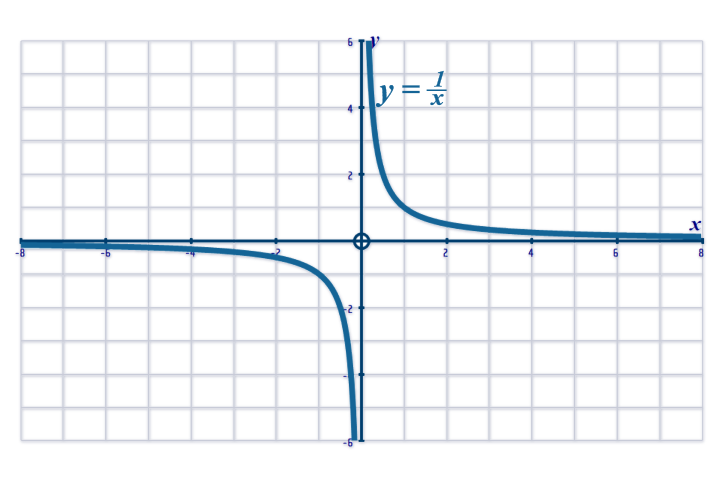
Below is a graph of the \(y=\frac{1}{x}\) curve (also called the "Reciprocal Curve"):
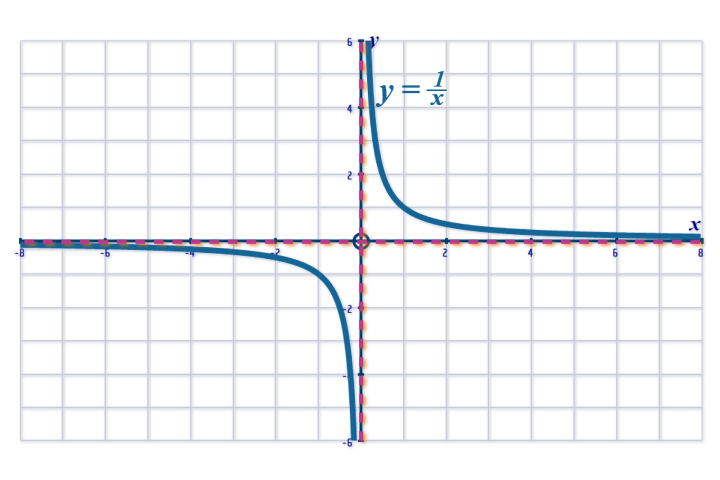
If you hover over the image (above), you'll see two lines appear: These are the asymptotes of the curve (lines the curve gets very, very close to - but never touches...). They are very much part of defining the curve and must be transformed along with the curve...
Starting with the curve of \(y=\frac{1}{x}\) (as shown above) and by using the same methods as in the movie, sketch the following curves. Use squared or graph paper and use a different grid for each curve:
For each question, you must also state clearly the transformations you have made
Example 1: Sketch: \(y=2+\frac{1}{x}\)
Re-write with a brackets around the ‘x’:

                      ┌──────────────┐
                      │              ▼
                      │   y  =  2 +  1
                      │         ▲  ( x )
                      │         │
                      │         │
                      │         └──────┐
                      │                │
                   ┌──┴──┐           ┌─┴──┐
      x ──────────► RECIP ──────────►│ +2 │
                   └──┬──┘           └─┬──┘
                     f(x)              │
                                       │
                             ┌─────────┴─────────┐
                         ┌───┘‘+2’ is after f(x) └───┐
                         │ Translate 2 units along y │
                         └─────────────┬─────────────┘
                ┌──────────────────────┴──────────────────────┐
                │Don't forget to move the horizontal asymptote│
                └─────────────────────────────────────────────┘
·
Example 2: Sketch: \(y=\frac{1}{x+3}\)
Since there is a 'sum' in the denominator, there should be brackets around the denominator:

                              ┌───────┐
                              ▼       │
                    y  =      1       │
                           (x + 3)    │
                              ▲       │
                              │       │
                     ┌────────┘       │
                     │                │
                   ┌─┴┐            ┌──┴──┐
      x ──────────►│+3│───────────► RECIP
                   └─┬┘            └──┬──┘
                     │              f(x)
                     │
              ┌──────┴───────────────┐
              │ ‘+3’ is before f(x): │
              │TRANSLATE ‘-3’ ALONG x│
              └──────┬───────────────┘
┌────────────────────┴──────────────────────┐
│Don't forget to move the vertical asymptote│
└───────────────────────────────────────────┘
·
Example 3: Sketch: \(y=-\frac{1}{x}\)
                      ┌────────────┐
                      │            ▼
                      │   y  =  –  1
                      │         ▲( x )
                      │         │
                      │         │
                      │         └──────┐
                      │                │
                   ┌──┴──┐          ┌──┴──┐
      x ──────────► RECIP ─────────►│ ×-1 │
                   └──┬──┘          └──┬──┘
                     f(x)              │
                                       │
                             ┌─────────┴─────────┐
                            ┌┘‘×-1’ is after f(x)└┐
                            │REFLECT IN THE x-AXIS│
                            └─────────────────────┘
·
Question 5: Sketch: \(y\,\,=\,\,2-\frac{1}{x-1}\)
Hints:

Since there are no brackets, first put a brackets around the x:

                    y  = 2  -    1
                              (x - 1)

The FLOW DIAGRAM looks like this:

x ──────────► -1  ───────────► RECIP ──────────► ×-1 ──────────► +2
             └─┬┘             └──┬──┘           └─┬─┘           └─┬┘
               ①               f(x)              ②              ③
    ┌──────────┴──────────┐                       │               │
     ‘+3’ is before f(x):                         │               │
    TRANSLATE ‘+1’ ALONG x           ┌────────────┴─────┐         │
                                     ‘×-1’ is after f(x)          │
                                      REFLECT IN x-AXIS      ┌────┴────┐
                                                              BLAH-BLAH


After you've sketched the transformed curve, don't forget to show the new asymptotes…
You can use this applet to check your answer:
Question 6: There are 12-parts to this question!
You have to IDENTIFY the equation of EACH of the 12-curves (from \(\left( a \right) \) to \(\left( l \right) \)!) in this applet...
Clue: The APPLET allows you to GUESS the equation and then to press ‘GO’ to see if your GUESS
was correct…

To figure out the correct equation, start by identifying these three things:

1) Where the vertical asymptote is
2) Where the horizontal asymptote is
3) If the curve has been flipped (i.e. is in the opposite quadrants from usual)

You might have to press ‘GO’ TWICE to see the transformations in your GUESS applied!
Transformation of a function (equation unknown):
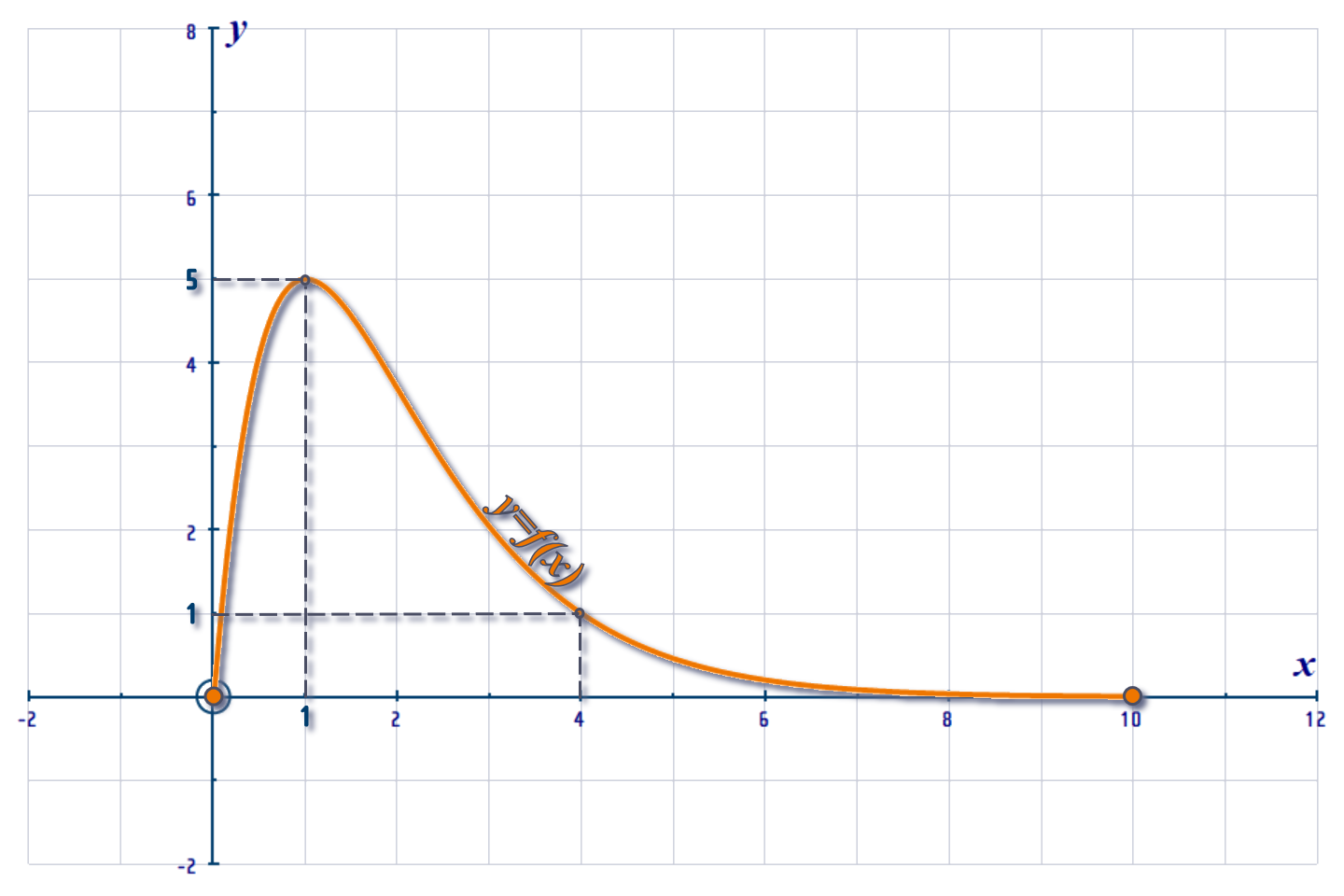
Below is a graph of \(y=f\left( x \right) \):
We are NOT told its equation: But we do know that \(f\left( x \right) \) is defined for \(0\leqslant x\leqslant 10\) and it has a root at \(x\,=\,0\) and another root at \(x\,=\,10\). The maximum point \(P\) is at \(\left( 1,5 \right) \).
It passes through the point \(Q\,=\,\left( 4, 1\right) \)
The RANGE of \(y=f\left( x \right) \) is: \(0\leqslant yx\leqslant 5\)
Armed with this information about \(f\left( x \right) \) and the curve of \(y=f\left( x \right) \) (as shown above) and by using the same methods as in the movie, sketch the following curves.
Use squared or graph paper and use a different grid for each curve:
For each question, you must:
State clearly the transformations you have made
Identify the point \(P'\) (where \(P\,=\,\left( 1,5 \right) \) is on the transformed curve); and if \(P'\) is a still maximum point
Identify \(Q'\) (where \(Q\,=\,\left( 4,1 \right) \) is on the transformed curve)
Identify where the points \(\left( 0,0 \right) \) and \(\left( 10,0 \right) \) have moved to; and determine if they are STILL roots
Question 7: Sketch: \(y\,=\,f\left( x+1 \right) \). You MUST:
i) State the transformations applied (in correct order)
ii) Show on your grid - IN PENCIL - the transformed graph at each step. Highlight the final answer with a thick marker
Identify clearly on your sketch:
iii) The END-POINTS of the transformed graph
iv) Where \(P\) has moved to: \(P'\) and if it is a still max or not
v) Where \(Q\) has moved to: \(Q'\)
PHEW!
Clue:

                          ┌───────────┐
                          ▼           │
                    y  =  f(x+1)      │
                              ▲       │
                              │       │
                     ┌────────┘       │
                     │                │
                   ┌─┴┐            ┌──┴──┐
      x ──────────►│+1│───────────► RECIP
                   └─┬┘            └──┬──┘
                     │              f(x)
                     │
               ┌─────┴──────────────────┐
               │  ‘+1’ is before f(x):	│
               │ TRANSLATE ‘⋯’ ALONG x	│
               └──────┬─────────────────┘
 ┌────────────────────┴───────────────────────┐
 │Don't forget to move P, Q and the end-points│
 └────────────────────────────────────────────┘


Here's an APPLET for you to check!
Question 8: Sketch: \(y\,=\,5\,-\,f\left( x \right) \). You MUST:
i) State the transformations applied (in correct order)
ii) Show on your grid - IN PENCIL - the transformed graph at each step. Highlight the final answer with a thick marker
Identify clearly on your sketch:
iii) The END-POINTS of the transformed graph
iv) Where \(P\) has moved to: \(P'\) and if it is a still max or not
v) Where \(Q\) has moved to: \(Q'\)
                      y = 5 - f(x)

The FLOW DIAGRAM looks like this:

x ───────────► RECIP ──────────► ×-1 ──────────► +5
              └──┬──┘           └─┬─┘           └─┬┘
                f(x)              ①              ②
                                  │               │
                                  │               │
                     ┌────────────┴─────┐         │
                     ‘×-1’ is after f(x)          │
                      REFLECT IN x-AXIS      ┌────┴────┐
                                              BLAH-BLAH


After you've sketched the transformed curve, don't forget to show where P, Q and
the end-points have moved to…

Remember, you can use the APPLET from Question 7 to check!
Question 9: Sketch: \(y\,=\,-\,f\left( x-4 \right) \). You MUST:
i) State the transformations applied (in correct order)
ii) Show on your grid - IN PENCIL - the transformed graph at each step. Highlight the final answer with a thick marker
Identify clearly on your sketch:
iii) The END-POINTS of the transformed graph
iv) Where \(P\) has moved to: \(P'\) and if it is a still max or not
v) Where \(Q\) has moved to: \(Q'\)
                      y = - f(x-4)

The FLOW DIAGRAM looks like this:

x ──────────► -4  ───────────► RECIP ──────────► ×-1
             └─┬┘             └──┬──┘           └─┬─┘
               ①               f(x)              ②
    ┌──────────┴─────────┐                        │
     ‘-4’ is before f(x):                         │
      So BLAH BLAH BLAH              ┌────────────┴─────┐
                                     ‘×-1’ is after f(x)
                                      So, BLAH, BLAH BLAH

Remember, you can use the APPLET from Question 7 to check!
Question 10: Sketch: \(y=5\,-\,f\left( x+1 \right) \). You MUST:
i) State the transformations applied (in correct order)
ii) Show on your grid - IN PENCIL - the transformed graph at each step. Highlight the final answer with a thick marker
Identify clearly on your sketch:
iii) The END-POINTS of the transformed graph
iv) Where \(P\) has moved to: \(P'\) and if it is a still max or not
v) Where \(Q\) has moved to: \(Q'\)
Clue:

The FLOW-DIAGRAM is:

      x ──────────► +1  ───────────► f(x)  ──────────► ×-1 ──────────► +5
                   └─┬┘                               └─┬─┘           └─┬┘
                     ①                                 ②              ③
          ┌──────────┴──────────┐                       │               │
           ‘+3’ is before f(x):                         │               │
          TRANSLATE ‘-3’ ALONG x           ┌────────────┴─────┐         │
                                           ‘×-1’ is after f(x)          │
                                            REFLECT IN x-AXIS      ┌────┴────┐
                                                                    BLAH-BLAH

Don't forget: You got to locate the points P’ and Q’ AND the end-points
Complete this web lesson on separate paper from any other homework
The pass mark (to avoid additional homework on this topic) is: 8/10