Page 65, Column 1
Area Scale Factors
If we know two shapes
are similar and we know the length scale factor then we can easily
find the area scale factor:
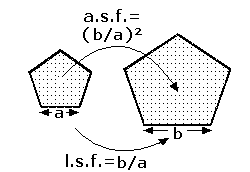
In the diagram above, the two pentagons are similar:
-
The length scale factor (from the small one to the large one)
is: × b/a
-
The area scale factor (from the small one to the large
one) is: × (b/a)²
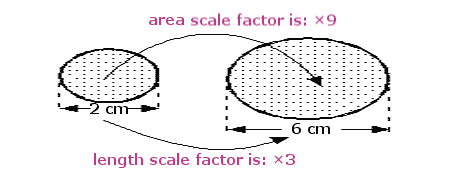
e.g. The two ellipses below are similar in shape. The smaller
ellipse is 2 cm long and the large ellipse is 6 cm long.
Given the area of the smaller ellipse is 12.4 cm², find the area
of the larger ellipse
small large
The length scale factor is: 2 cm ——————————► 6 cm
So, the area scale factor is: (2 cm)² ——————————► (6 cm)²  square
Which simplifies to: 4 cm² ——————————► 36 cm²
The area of the small one is 12.4 cm²: 12.4 cm² ——————————► ... ×12.4/4
So, the answer is: 36 × 12.4 = 111.6 cm²
4
Note an alternative method is to say the length scale factor is: ×3
so, the area scale factor is: ×9
so, the area is: 12.4 × 9 = 111.6 cm² square
Which simplifies to: 4 cm² ——————————► 36 cm²
The area of the small one is 12.4 cm²: 12.4 cm² ——————————► ... ×12.4/4
So, the answer is: 36 × 12.4 = 111.6 cm²
4
Note an alternative method is to say the length scale factor is: ×3
so, the area scale factor is: ×9
so, the area is: 12.4 × 9 = 111.6 cm²
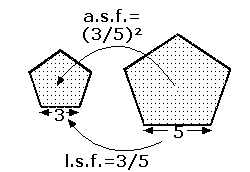
e.g. In the diagram below, the area of the larger pentagon is
75cm². Find the area of the smaller cone:
small large
The length scale factor is: 3 cm ——————————► 5 cm
So, the area scale factor is: (3 cm)² ——————————► (5 cm)² square
Which simplifies to: 9 cm² ——————————► 25 cm²
The area of the small one is 75 cm²:  ... cm² ◄—————————— 75 cm²
So, the answer is: 9 × 75 = 27 cm²
25
Note an alternative method is to say the length scale factor is: ×3/5
so, the area scale factor is: ×9/25
so, the area is: 75 × 9/25 = 27 cm² ... cm² ◄—————————— 75 cm²
So, the answer is: 9 × 75 = 27 cm²
25
Note an alternative method is to say the length scale factor is: ×3/5
so, the area scale factor is: ×9/25
so, the area is: 75 × 9/25 = 27 cm²
Ratios and Scale Factors
-
Ratios and Scale Factors are largely interchangeable, with
certain provisos
-
Ratios do not have units whereas scale factors do
-
You can change a ratio to a scale factor, by adding
appropriate units.
For instance, if your ratio is a ratio of
lengths, then the units you add must be units of length
(i) If two lengths are in the ratio 2
: 3
Then we can write:	2 cm ——————————► 3 cm

We could also write:	2 m  ——————————► 3 m

Or, we could write:	2 inches ——————► 3 inches
(ii) If two areas are in the ratio 2
: 3
Then we can write:	2 cm² ——————————► 3 cm²

We could also write:	2 m²  ——————————► 3 m²

Or, we could write:	2 inches² ——————► 3 inches²
-
You can change a scale factor into a ratio as long as the
units in the scale factor are the same:
(i) A scale factor of 5 cm ------> 8 cm can be
written as:
A ratio (of lengths) 5 : 8
(ii) A scale factor of 5 cm ------> 3 m must first be
re-written so the units at both ends are the same:
Making the units the same at both ends:		  5 cm ——► 300 cm

Ratio (of lengths)				  5    :   300
						 �E       �E
						  ------------
Which simplifies to				  1    :   60
-
A ratio of lengths (or a length scale factor) CANNOT be used
for areas. It must first be changed into a ratio of areas:
(i) To change a ratio of lengths to a ratio of areas,
you must square it
(ii) To change a ratio of lengths to a ratio of volumes, you
must cube it
(iii) To change a ratio of areas to a ratio of lengths, you must
square-root it
(iv) To change a ratio of volumes to a ratio of lengths, you
must cube-root it
e.g. In the example above, we found that if the area of the
large pentagon is 75 cm² then the area of the small pentagon was
27cm²
(i) What is the ratio of the lengths
(ii) What is the ratio of the areas
(iii) What is the relationship between the answers to (i) and (ii)
So, the lengths are:		Small :	Large
				3 cm  : 5 cm
Removing the units:		  3   :   5  = Ratio of Lengths

And, the areas are:		27cm² : 75cm²
Removing the units:		  27  : 75
Dividing by '3'			  �E    �E
				  --------
				  9   :  25  = Ratio of Areas

The relationship is: (ratio of lengths)² = ratio of areas
Question 1: The area scale
factor is:
18 cm² ——► 8 cm²
Since the units
are the same, we can remove them and write:
			18 cm² :    8 cm²

Ratio of areas:		18     :    8
This cancels
down:
Ratio of areas:		18     :    8
			�E         �E
			-------------
Ratio of areas:		 9     :    4
Now, to get from the "RATIO OF AREAS"
to the "RATIO OF LENGTHS",
we square-root:
Ratio of areas:		 9     :    4
			 √          √
			-------------
Ratio of lengths:	 3     :    2
Now, to find the missing length, we can use either the ratio
of lengths, or we can use the length scale factor (I
prefer to use the length scale factor): large small
3 cm ——————————► 2 cm
�Ecm ◄—————————— 6 cm
Question 2: The area scale
factor is:
8 cm² ——► 2 cm²
Since the units
are the same, we can remove them and write:
			 8 cm² :    2 cm²

Ratio of areas:		 8     :    2
This cancels
down:
Ratio of areas:		 8     :    2
			�E         �E
			-------------
Ratio of areas:		 �E    :    1
Now, to get from the "RATIO OF AREAS"
to the "RATIO OF LENGTHS",
we square-root:
Ratio of areas:		 �E    :    1
			 √          √
			-------------
Ratio of lengths:	 �E    :    1
Now, to find the missing length, we can use either the ratio
of lengths, or we can use the length scale factor (I
prefer to use the length scale factor): large small
�Ecm ——————————► 1 cm
�Ecm ◄—————————— 6 cm
Question 5: The only trick here is that one of them has been
drawn upside down. Redraw it the right way up�E
Question 6: The length scale factor is:
				large		  small
				 10 cm ——————————► 4 cm
This cancels down to:
				large		  small
				 10 cm ——————————► 4 cm
				 �E                �E
				 ----------------------
				  5 cm ——————————► 2 cm
But, since we want to find an area, we need to square
this scale factor to get the area scale
factor:
				large		  small
				25 cm² ————————�E#9658; 4 cm²
Finally:
				large		  small
				25 cm² ————————�E#9658; 4 cm²
				50 cm² ————————�E#9658; �Ecm²
Question 7: Since AB and PQ are both LENGTHS, the ratio of
lengths is 3 : 2
i.e 				large		  small
				3 cm  ————————�E#9658;  2 cm
We
need to convert an area, so the area scale factor is �E
|