Page 61, Column 1Surface AreasThe "NET" of a shape helps us to determine its surface area. The "NET" is the shapes of paper we would need in order to fold/roll and stick together to create the 3-dimensional object
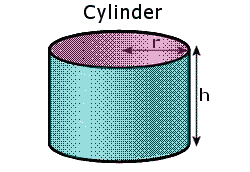
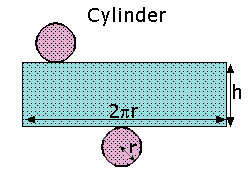
CylindersThe net of a cylinder is made up of two small circles and a long rectangle:
The two circles form the base and lid of the cylinder and the rectangle forms the curved surface of the cylinder:
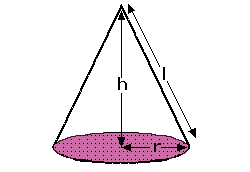
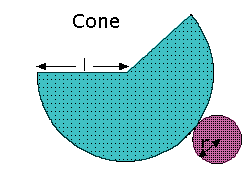
e.g. A cylinder has height 4 cm and base radius 3 cm. Find its surface areah = 4cm ┐ r = 3 cm | S = ??? ┘ S = 2лrh + 2лr² = 2л(3)(4) + 2л(3)² = 42л cm² e.g. A cylinder of height 6 cm has surface area of 32л cm². Find its base radiush = 6 cm ┐ r = ??? | S = 32л cm² ┘ S = 2лrh + 2лr² 32л = 2лr(6) + 2лr² 32л = 12лr + 2лr² ÷2л ÷2л ÷2л ---------------------- 16 = 6r + r² -16 -16 ------------------------ 0 = r² + 6r - 16 => 0 = (r + 8)(r - 2) => ConesThe net of a cone is made up of a small circle and a sector of a large circle:
The full circle forms the base of the cone and the sector forms the curved surface of the cone:
e.g. A cone has height 4 cm and base radius 3 cm. Find its surface areah = 4 ┐ r = 3 | l = ??? | We need 'l' : l² = h² + r² A = ??? ┘ (the slant height) l² = 4² + 3² l = 5 cm Area of curved surface = лrl (i.e. sector of net) = л(3)(5) = 15л cm² Area of base of cone = лr² = л(3)² = 9л cm² Total area = 15л + 9л = 24л cm² Volume of a Sphere
e.g. A sphere has radius 2 cm. Find its volumer = 2 ┐ V = ??? ┘ V = 4лr² 3 = 4л(2)² 3 = 16л cm² 3 Surface area of a SphereThe net for a sphere is impossible to flatten out - but it looks a bit like this:
e.g. A sphere has radius 2 cm. Find its surface arear = 2 ┐ S = ??? ┘ S = 4лr² = 4л(2)² = 16л cm² Question 1: The volume is given by: r = 3 ┐ V = ??? ┘ V = 4лr² 3 = 4л(3)² 3 = ...л cm² Question 7: A hemisphere is HALF a sphere, so we work out the volume of a whole sphere - then halve it...
Question 8: Working out the volume of a sphere of radius 1.2 cm and multiplying that by 20 givens the volume of the cuboid...
Question
10 part (a): It is easy to use Pythag to work out the
hypotenuse (i.e. slant height) Question 10, part (b): Separating the object into a cone and a hemisphere: The net for a cone (excluding the base circle of the cone) is:
The net of a hemisphere is:
Question 12: The net for a cone (excluding the base circle of the cone) is:
The net of the cylinder (open toped and open bottomed) is:
Question 17: It doesn't matter is the pencil has a circular cross section, or a triangular cross section of e hexagonal cross section... ...the end of a pencil is a type of "pyramid", so the same formula applies: A = 1/3 × area of base × height
Question 19: So, we can work out the volume of the sphere: V = ... cm³ Since the cylinder has the same volume: Volume of cylinder = лr²h │ └┐ ... = л(…)²h ÷… ÷… ------------ … = h Question 20: Since height is twice radius: height is twice radius ╘═══╤══╛╘═╤╛╘══╤══╛╘═══╤══╛ h = 2× r And, using the equation for the volume of a cylinder: Volume of cylinder = лr²h │ │ └┐ ... = лr²(2r) Solving...
|