Page 58, Column 1Surface AreasThe "NET" of a shape helps us to determine its surface area. The "NET" is the shapes of paper we would need in order to fold/roll and stick together to create the 3-dimensional object
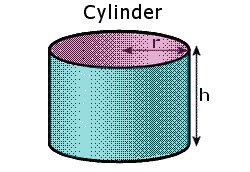
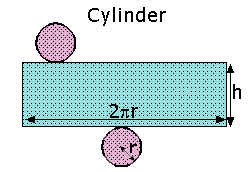
CylindersThe net of a cylinder is made up of two small circles and a long rectangle:
The two circles form the base and lid of the cylinder and the rectangle forms the curved surface of the cylinder:
e.g. A cylinder has height 4 cm and base radius 3 cm. Find its surface area
  h = 4cm  ┐
  r = 3 cm |
  S = ???  ┘		S  =	2лrh     +  2лr²
			   = 	2л(3)(4) +  2л(3)²
			   =	42л cm²
e.g. A cylinder of height 6 cm has surface area of 32л cm². Find its base radius h = 6 cm ┐
r = ??? |
S = 32л cm² ┘ S = 2лrh + 2лr²
32л = 2лr(6) + 2лr²
32л = 12лr + 2лr²
÷2л ÷2л ÷2л
----------------------
16 = 6r + r²
-16 -16
------------------------
0 = r² + 6r - 16
=> 0 = (r + 8)(r - 2)
=>
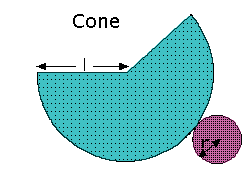
ConesThe net of a cone is made up of a small circle and a sector of a large circle:
The full circle forms the base of the cone and the sector forms the curved surface of the cone:
e.g. A cone has height 4 cm and base radius 3 cm. Find its surface area
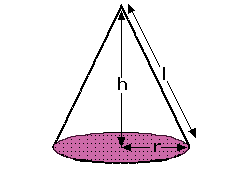
h = 4 ┐ r = 3 | l = ??? | We need 'l' : l² = h² + r² A = ??? ┘ (the slant height) l² = 4² + 3² l = 5 cm Area of curved surface = лrl (i.e. sector of net) = л(3)(5) = 15л cm² Area of base of cone = лr² = л(3)² = 9л cm² Total area = 15л + 9л = 24л cm² SpheresThe net for a sphere is impossible to flatten out - but it looks a bit like this:
e.g. A sphere has radius 2 cm. Find its surface arear = 4 ┐ S = ??? ┘ S = 4лr² = 4л(2)² = 16л cm² Where-ever possible, try to give your answer both exactly and to 4 s.f.Question 1: The net of the cylinder (open topped and open bottomed - i.e. only the curved surface of the cylinder) is:
r = 4 cm and h = 6 cm: S = 2лrh = 2л(4)(6) = ...л cm² ≈ 150.8 cm² Question 4: Watch out! They've tried to trick us by mixing different units... If we want to give our answer in m² then we must make sure all the measurements are in 'm' before we find the surface area: h = 0.82 m ┐ r = 2 m | S = ??? ┘ S = 2лrh = 2л(2)(0.82) = --л m² ≈ 10.3 m²
Question 5: Again, watch the units. This time it makes more sense to convert everything to 'cm' (if you don't believe me, try it using 'm' instead to see why!): r = 6 cm and h = 32 cm: h = 0.82 m ┐ r = 2 m | S = ??? ┘ S = 2лrh = 2л(6)(32) = ---л cm² ≈ ---cm²
Question 9: We know that, in the equation: S = 2лrh + 2лr² └——┬—┘ └—┬——┘ │ │ Area Area of curved surface of base and lid
Question 11: Start by drawing a net of the soup tin (it will look just look the net of a cylinder below):
Then, on top of this, draw the label [which covers the curved surface (i.e. the area shaded cyan) of the cone, but has an overlap of 1 cm, so it is 1 cm longer]... So the curved surface of the tin is a rectangle: 9.6 cm by
20.7 cm
Question 13: The area of the curved surface of the roller tells us the area it rolls in one revolution...
Question 14: Our drawing of the net of a cone looks like this:
The area shaded in cyan makes the curved surface of the cone, whereas the area shaded in purple makes the base: S = лrh + лr² └—┬—┘ └—┬—┘ │ │ Area Area of curved surface of base Since we only want the area of the curved surface: r = 4 cm ┐ l = 10 cm | Ac = ??? ┘ Ac (Curved Surface Area)= лrl = л(4)(10) = ...л cm² ≈ 125.7 cm² Question 18: The total surface area is given by: S = лrl +
лr²'. r = 4 cm ┐ l = 9 cm | A = ??? ┘ Area of curved surface = лrl (i.e. sector of net) = л(4)(9) = ..л cm² Area of base of cone = лr² = л(4)² = 16л cm² Total area = ..л + 16л = 54л cm² ≈ ... cm²
Question 20: It its radius is 'r' then its width (i.e. its diameter) is '2r'. Since it is 'twice as high as it is wide': height is twice the width └——————┘└——┘└—————┘ └—————┘ h = 2× w └—————┘ => h = 2× (2r) => h = 4r Now, using the equation for JUST the curve surface area: h = 4r ┐ r = r | Ac = ?? ┘ (curved surface area) Ac = 2лrh 150 = 2л(r)(4r) => ... = r Question 21, part (ai): Looking at just one of those quarter circles, it is easy to see that the radius must be 4 cm Work out the circumference of a circle of radius 4 cm. We need
one quarter of that for the arc, but then we have four of the
arcs... Question 21, part (aii): The shaded area = area of the
square SUBTRACT the area of the four "quarter-circles" Question 21, part (aiii): The percentage wasted is found by: This is the area of the square sheet of metal ┌———————————————————————————————————————————————┐ 100% ——————————► total area of metal needed to make the pressing
Question 22: A map scale is really a "LENGTH SCALE FACTOR". So, a scale of 1: 50,000 could be written as: Map Actual 1 cm ——————————► 50,000 cm And, by changing the 50,000 cm into 'm', the same scale can be written as: Map Actual 1 cm ——————————► 500 m And again, changing the 500 m into 'km': Map Actual 1 cm ——————————► ½ km And remember, all of these are the same as saying: 1:50,000 Now, we want to convert 3.8 cm² on the map, to a real life measurement, so we need the "AREA SCALE FACTOR", which we get by squaring the LENGTH SCALE FACTOR: Map Actual LENGTH SCALE FACTOR: 1 cm ——————————► ½ km SQR SQR ----------------------- AREA SCALE FACTOR: 1 cm² ——————————► ¼ km² Using this area scale factor, we can now convert the 3.8 cm²...
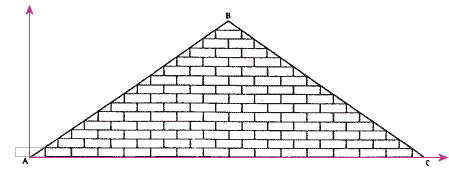
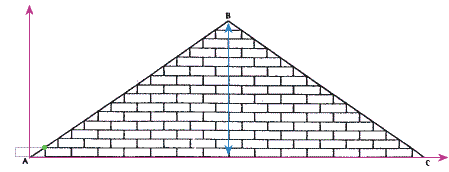
Question 23, part (a): So, what they are really telling us is that each row has one less brick than the row above it... Which means that the left edge of the 1st brick in the 2nd row is placed onto the middle of the 1st brick in the 1st row. Now, imagine you have a set of 'x' and 'y' axes coming out of the top left corner of the 1st brick in the 1st row (I've also add in an imaginary extra brick to the left of the 1st brick):
Now, we need to find the coordinates of the top-left-corner of the 1st brick (I've marked it with a green dot: ●):
To get from the origin to the ●, the amount you have to move along 'x' is half the length of a brick and the amount you have to move along 'y' is the height of a brick. Taking this (right-angled) triangle out, we want θ and we know 'A' and 'O', so we use: A = ... ┐ O = 70 mm | θ = ??? ┘ tan θ = O A Etc... |
 ??? ◄—————————— area of metal that is wasted